The sidereal zodiac
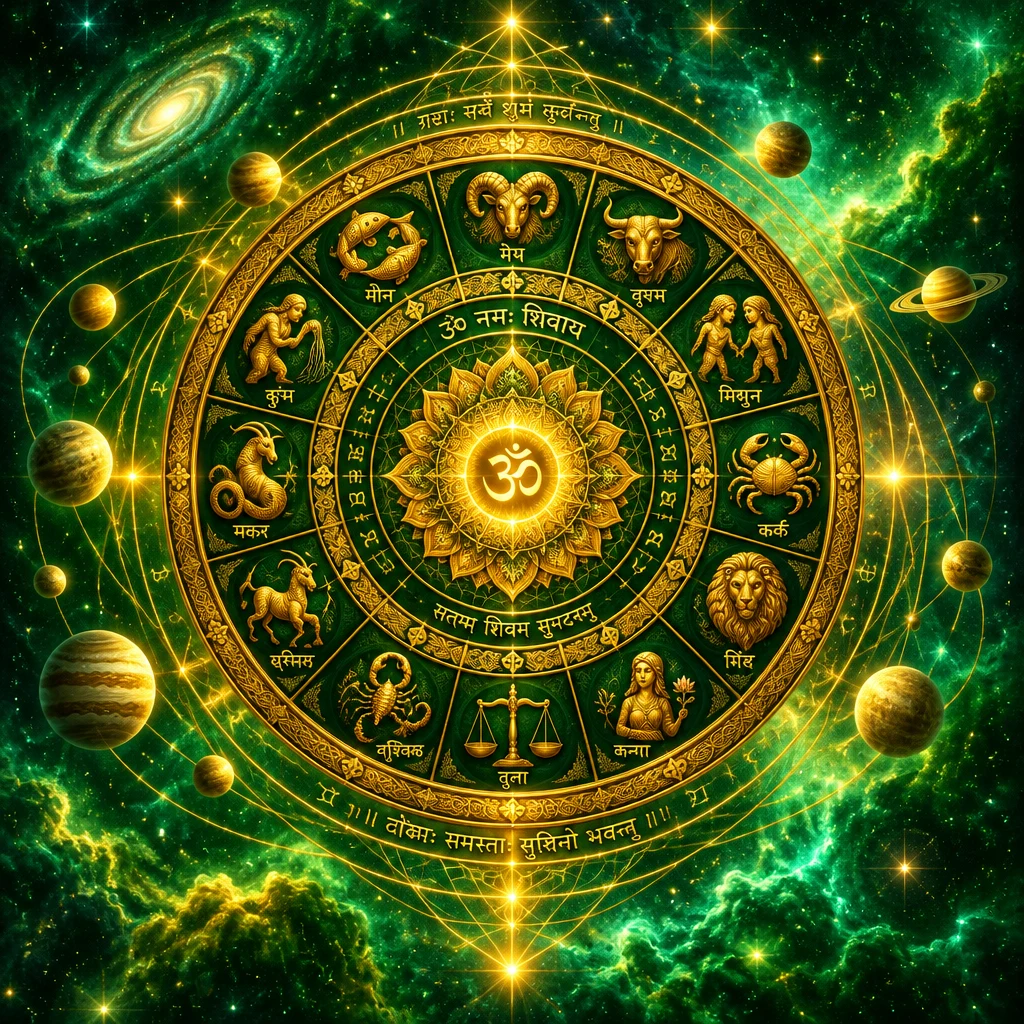
Jyotish uses the sidereal zodiac, which is aligned with the positions of the constellations. This means your signs may differ from those you know from Western astrology.
Discover the sidereal zodiacJyotish · djotiš · the light of time
Jyotish, also written as djotiš in Slovenian, is the traditional Indian system of astrology. It reads the birth chart as an interplay of potential, karma and time—not to take away your freedom to choose, but to help you recognise it more clearly.
What You Take Away
Jyotish uses the sidereal zodiac, which is aligned with the positions of the constellations. This means your signs may differ from those you know from Western astrology.
Discover the sidereal zodiacThe Sun, Moon, five visible planets and the lunar nodes Rahu and Ketu represent different forces, desires, lessons and ways of acting in the chart.
Meet all nine grahasPlanetary periods help explain why a particular theme becomes more prominent at a certain time. They do not tell you what you must do, but show where energy is concentrated.
Explore planetary periodsThe chart reveals inherited patterns and ways to engage with them consciously. Dharma speaks of the path on which your abilities find a deeper purpose.
Read about karma and dharmaHow the Consultation Works
You send your precise birth details and choose the area you would first like to explore.
Klara reviews your birth chart, planetary periods and significant current transits.
In a personal consultation, you receive an integrated interpretation and guidance grounded in your everyday life.
Jyotish means “the science of light” in Sanskrit. In the Vedas, it is called the eye of the Vedas because it helps us see a path when we feel lost. It rests on the belief that our karma is connected to the positions of the planets and stars — the birth chart is therefore a map of the karma we bring into this life.
The Earth wobbles slightly as it rotates — this is called precession. As a result, the sky shifts by roughly one degree every 72 years. Vedic astrology accounts for this shift and calculates using the actual positions of the stars, while Western astrology retains the older, symbolic division. This is why your Sun sign in Jyotish is often different — and why daily newspaper horoscopes have nothing to do with this tradition.
According to the Vedas, two forces shape our future: destiny and free will. Destiny is the circumstances we encounter. Free will is how we respond to them. Every response creates new karma — so through our choices, we shape our own future circumstances. Astrology shows us the map, but we choose the path ourselves.
The Vedas recognise four aims of life: dharma — living in harmony with your nature; artha — security and resources; kama — joy and desire; and moksha — inner freedom. Your birth chart helps you understand where you are on this journey and how to direct your energy towards what brings the greatest meaning.
Astrological and karmic insights are intended for self-understanding and personal reflection. They do not replace medical, psychological, legal or financial advice, nor do they determine an unchangeable future.
Frequently Asked Questions
These are different names and spellings for the same tradition. The word Jyotish is often translated as knowledge or light that illuminates time.
Vedic astrology uses the sidereal zodiac, while Western astrology mostly uses the tropical zodiac. This difference does not mean that one chart is wrong; they are two different systems of interpretation.
No. It describes patterns, potential and the quality of time. Awareness allows you to respond more thoughtfully.
A deeper exploration
Both systems look at the same sky, but read it through different maps. The distinction is not about which one is ‘right’, but about the question you are asking. If you want to understand who you are, a Western chart offers an excellent mirror. If you want to understand where you are in your life story and how to respond to the time ahead, Jyotish speaks to that.
Western astrology uses the tropical zodiac, tied to the seasons and equinoxes. Vedic astrology uses the sidereal zodiac, aligned with the actual constellations and adjusted for a shift known as ayanamsha—currently around 24 degrees. This is why your sign in Jyotish is often one sign earlier. It is not a mistake, but a different coordinate system.
The Western approach reads time primarily through the planets’ current transits. Jyotish adds a system of planetary periods—Vimshottari dashas—which reads your life in chapters: not just what is happening in the sky, but which chapter of your life is unfolding now.
The Western tradition emphasises the Sun; Jyotish gives a central role to the Moon and its lunar mansion, or nakshatra. Each of the 27 nakshatras has its own deity, symbol and psychological undertone, revealing more about your inner nature than the Sun sign alone.
Jyotish reads the chart as a map of karma: what has been inherited, where the lessons lie and which path gives your abilities a deeper purpose. Western psychological astrology focuses more on personality, needs and the development of the ego. The approaches are not mutually exclusive—together, they address both ‘who am I?’ and ‘why am I here?’
Jyotish works with nine grahas, or planetary influences: the Sun, Moon, Mars, Mercury, Jupiter, Venus and Saturn, along with the lunar nodes Rahu and Ketu—the points where the paths of the Sun and Moon intersect. Rahu and Ketu describe the pull of the past and the direction of growth, for which the Western system has no equivalent tool.
Western astrology excels at describing personality and relationships. Jyotish adds a practical dimension of timing: muhurta (choosing an auspicious moment), Sade Sati (Saturn’s testing period), annual forecasts and karmic diagnostics. This is why it has traditionally been a system of guidance, not merely description.
How do we work together? At Magic Klara, our work together begins with traditional Jyotish—Lahiri ayanamsha, Vimshottari dashas and nakshatras—and, where helpful, connects it with Western mystery traditions: Kabbalah, gnosis and alchemy. The result is not a confusing blend of two systems, but a clear, warm perspective without fear or a fixed destiny.
Keep Exploring