
Home/Nakshatras/Krittika
Nakshatra 03 · ruler Sun
Krittika
Krittika
Krittika is the blade of discernment and the fire of Agni, purifying, separating the essential from the unnecessary, and supporting ambition. It brings strong will, dignity, creative power, and the ability to act with clarity. Its wisdom lies in using its sharpness truthfully, but without unnecessary criticism, haste, or susceptibility to anger.
- Range
- 26°40′ Aries – 10°00′ Taurus
- Ruler (dasha period)
- Sun
- Deity
- Agni
- Symbol
- Blade
- Gana (temperament)
- Rakshasa (fierce)
- Keywords
- —
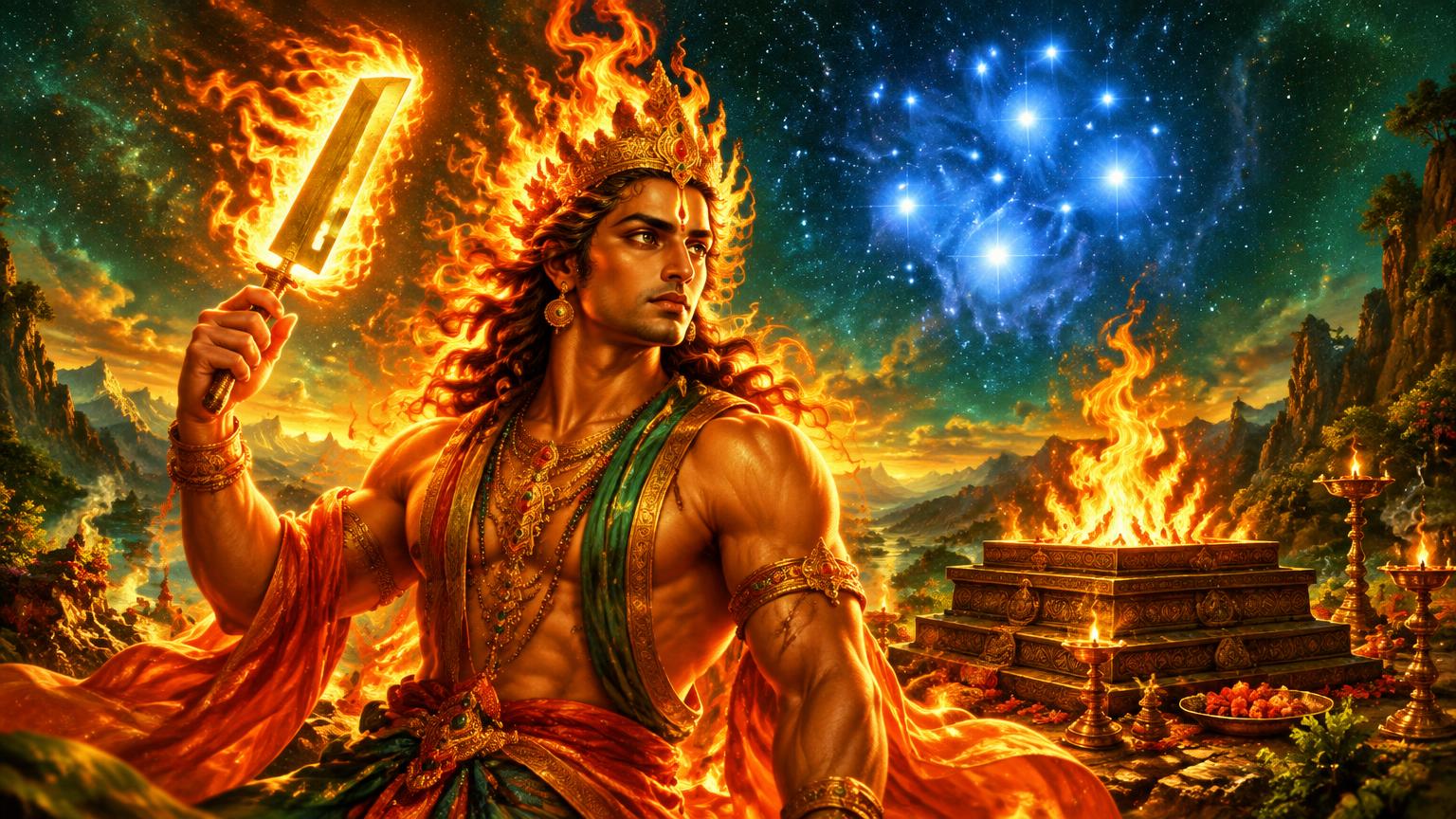
Kritika – the fire that discerns and nurtures
Kritika is the third of the 27 nakshatras, or lunar mansions. It extends from 26°40′ Aries to 10°00′ Taurus in the sidereal zodiac. Its planetary ruler is the Sun. Its first quarter lies in Mars-ruled Aries. The remaining three quarters lie in Venus-ruled Taurus.
Its central theme is discernment. What is essential? What is unnecessary? What needs nurturing, and what calls for a clean cut? Kritika seeks to remove whatever obscures the core.
Yet its fire is not intended only to destroy. Fire also cooks food, warms a room and makes transformation possible. Mature Kritika combines sharp judgment with care for life.
In Jyotish, or Vedic astrology, this is a symbolic framework for reflection. It is not a scientifically validated description of personality or a prediction of the future.
Essential details
- Number in sequence: 3
- Range: 26°40′ Aries–10°00′ Taurus
- Nakshatra ruler: the Sun, or Surya
- Sign rulers: Mars in Aries and Venus in Taurus
- Deity: Agni, the deity of fire
- Main symbol: a blade, knife or razor
- Other symbol: a flame
- Stellar association: the Pleiades
- Shakti: Dahana shakti, the power to burn
- Elemental symbolism: fire
- Guna: rajas, the quality of activity
- Life motivation: kama, desire and fulfilment
- Animal symbol: sheep
Different schools of astrology interpret some classifications differently. The central association remains clear: Agni, the blade, transformation and nourishment. These symbols describe different tasks of the same power. Sometimes something needs to be removed. At other times, the flame needs protecting so it does not go out.
Agni and the myth of the Pleiades
In Vedic tradition, Agni is the fire of the hearth and of ritual. He mediates between the human and the divine. He receives the offering and transforms it through fire. He therefore represents more than heat. He also represents the passage from one form to another.
In Kritika’s symbolic language, Agni reveals what remains when excuses fall away. He tests words against actions. Promises against responsibility. Knowledge against its usefulness. His fire calls for honest engagement with the life we actually live.
Kritika is also associated with the Pleiades, known in Indian tradition as the Krittikas. In widely told versions of the myth, six Krittikas nurture the child Skanda, also known as Kartikeya. His six faces allow him to receive care from all six mothers. The details of the story differ between traditions.
This myth adds another dimension to the image of sharpness. Kritika is not only the one who cuts. She is also the one who nourishes something young and vulnerable. Her firmness can create a safe space for growth.
Agni and the Krittikas thus bring together two tasks: transforming what is no longer useful and nurturing what is precious.
The symbolism of the blade and fire
A blade separates. We can use it to prepare food, shape material or remove an unwanted part. Its value depends on intention, skill and restraint. The same is true of a sharp word.
Kritika’s judgment can quickly detect inconsistency. It notices the gap between what someone says and what they do. Yet an observation is not the same as complete understanding. It needs to be checked before a conclusion is drawn.
Fire, meanwhile, changes matter. What is raw can become useful. Through work, an unstructured idea can take on a clear form. Here lies the capacity for sustained improvement.
The shadow emerges when removing things becomes an end in itself. A person then cuts even where a conversation would have been enough. A mature use of both symbols therefore includes the question: What do I want this action to preserve, not just eliminate?
Shakti – the power that burns away the unnecessary
Kritika’s traditional power is Dahana shakti, the power to burn. It speaks of fire that transforms matter and removes what cannot remain in its present form.
In everyday life, this symbol might mean letting go of an empty promise. It might mean ending an ineffective procedure. Or it might mean having the courage to acknowledge our own mistake and change our behaviour.
The distinction between purification and punishment matters. The first seeks clarity and better conditions. The second seeks someone to blame and a sense of superiority. Kritika loses its way when it treats every imperfection as unacceptable.
Its mature shakti does not demand a perfect world. It asks for an honest relationship with reality. Let the fire remove the obstacle, not a person’s dignity. Transformation only makes sense when it leaves room for life.
The Sun through Aries and Taurus – from initiative to value
As the nakshatra ruler, the Sun emphasises identity, dignity, responsibility and the need for inner direction. Kritika wants to know what it stands for. A vague answer rarely satisfies it.
In Aries, ruled by Mars, the solar theme connects with initiative and courage. The Sun is traditionally exalted in this sign. This does not mean that every placement is automatically favourable. It does, however, emphasise the symbolism of independent action and a decisive beginning.
In Taurus, ruled by Venus, fire meets earth. Quality, materials, resources and lasting value come to the foreground. The question is no longer simply what to begin. What is worth maintaining also becomes important.
There is a creative tension between the two parts. Aries intervenes quickly. Taurus wants to preserve stability. The Sun seeks its own standard, while Venus considers comfort and connection. Mature Kritika can therefore initiate change and then patiently tend to its consequences.
Inner world and character
When Kritika is prominent in a chart, it can symbolise a strong need for clarity. Honest speech, quality and consistency between intention and action may matter deeply to the person.
Unclear agreements may tire them more than demanding work. Collaboration is easier when they know the criteria. They often want to understand what their responsibility is and where the other person’s responsibility begins.
Possible expressions of this archetype include:
- directness and an instinct for what matters,
- high standards at work,
- a protective attitude towards what has been entrusted to them,
- a willingness to take the initiative,
- a dislike of pretence,
- satisfaction in visible improvement.
Beneath the decisiveness, there may be sensitivity to disrespect. It is therefore helpful to distinguish between disagreement over an issue and personal rejection. Not every correction is an attack on someone’s worth.
Kritika’s gifts
Clear discernment
Kritika can draw the decisive detail out of a mass of information. It recognises which question needs to be addressed first. This gift becomes more reliable when it includes a willingness to revise a first impression.
The courage to make a necessary cut
Sometimes the problem is not a lack of understanding but procrastination. Kritika can help someone say a clear no, end an ineffective procedure or stop behaviour that crosses agreed boundaries.
An appreciation of quality
It is not always interested in having the greatest quantity. What matters is whether something works and whether it is well made. This gift develops through practice, checking and respect for detail.
Protective care
The myth of the Krittikas reminds us that strength can serve nurture. Firmness makes it possible to protect time, space and resources for something still growing. Care here often takes a tangible form.
Turning knowledge into action
Kritika can connect insight with implementation. It does not stop at identifying what is not working. It finds a correction, tests it and monitors the result. In this way, sharpness becomes useful, not merely convincing.
Shadow sides and inner challenges
The gift of discernment can turn into constant evaluation. High standards can become impatience. Protectiveness can become control. A person starts seeing faults everywhere and struggles to recognise work that is good enough.
Common challenges of this archetype include:
- correcting others without being invited,
- using an overly harsh tone to make a valid point,
- demanding immediate results,
- feeling ashamed of one’s own imperfections,
- clinging to a conclusion out of pride,
- confusing honesty with a lack of consideration.
A particularly difficult habit is measuring our own worth or that of others solely by efficiency. Relationships are not products. Grieving, learning and building trust do not always have a quick fix.
The central question of the shadow is: Do I want to improve something, or prove that I am right? Maturity also shows in the ability to put the blade down.
The four padas – four ways of expressing the energy
Each pada, or quarter, spans 3°20′. Its navamsha, a subdivision used in Jyotish, adds a particular mode of expression. It does not replace the sign, house or meaning of the graha—the planet or astrological factor—placed there.
1st pada: 26°40′–30°00′ Aries · Sagittarius navamsha
The first pada brings together Mars’s initiative, the Sun’s direction and Jupiter’s search for meaning. Sharpness seeks to serve a principle. Questions of truth, ethics, learning and the courage to take a public stand may come to the foreground.
Its gift is the ability to advocate clearly for an important value. Its shadow is moral certainty that leaves no room for questions. A mature expression checks the facts and distinguishes between a principle and a personal interpretation. A conviction becomes stronger when it can withstand respectful doubt.
2nd pada: 0°00′–3°20′ Taurus · Capricorn navamsha
The second pada gives the fire a framework. Saturn’s navamsha emphasises discipline, responsibility and gradual building. Clarity is expressed through organisation, standards and the ability to complete a demanding task.
Its gift is reliability without unnecessary display. The challenge arises when a person becomes relentless with themselves or measures their worth only through achievements. They need realistic deadlines and permission to rest. Good structure supports life; it does not demand constant proof of worth.
3rd pada: 3°20′–6°40′ Taurus · Aquarius navamsha
The third pada directs discernment towards systems and community. Here too, Saturn traditionally rules the navamsha. Rules, social agreements and the question of who benefits from a particular arrangement may draw attention.
Its gift is the ability to propose a thoughtful improvement to a wider process. Its shadow is cold criticism and distance from individual experience. A mature expression connects principle with real people. Before making a change, it listens to those who will live with its consequences.
4th pada: 6°40′–10°00′ Taurus · Pisces navamsha
The fourth pada connects Kritika’s sharpness with Jupiter’s breadth and the sensitivity of Pisces. The question arises of how to tell the truth without losing compassion. Creativity can help express what a direct argument cannot capture.
Its gift is gentle but clear discernment. Its challenge is swinging between idealisation and a disillusioned severing of ties. Agreements that can be checked and simple boundaries are helpful. Compassion does not require overlooking facts. Nor does clarity require giving up closeness.
The Moon in Kritika
In a symbolic reading, a natal Moon in Kritika can emphasise a need for emotional clarity. Security is connected with reliability, honesty and the feeling that words mean something.
Care may be expressed practically. Someone prepares a meal, tidies a space or removes an obstacle. Yet help is not always what the other person needs. Sometimes they simply want to be heard without receiving advice.
Hurt may bring a sharp response. Beneath it, there may be disappointment, uncertainty or a feeling that one’s effort has gone unnoticed. It is helpful to name the feeling first, and only then assess the other person’s behaviour.
Aries and Taurus give this Moon different contexts. In traditional Jyotish, the Moon is exalted in Taurus. This, too, is no guarantee of an easy emotional life. Interpretation includes the house, aspects, the Sun and the chart as a whole.
Relationships and closeness
In relationships, Kritika symbolises a desire for honesty and consistency. Empty promises can be more troubling than open disagreement. Closeness grows when small actions uphold agreements.
Difficulty arises when a loved one becomes an improvement project. Constant advice can sound like a message that they are not good enough. Mature care allows for a different pace and different choices.
Growth in relationships involves three tasks:
- Express a need without passing judgment. Instead of making an accusation, describe the event, the feeling and what you would like.
- Ask before correcting. Check whether the other person wants help, an opinion or simply your presence.
- Repair the effects of harshness. Pair an apology with changed behaviour, rather than a defence of good intentions.
A nakshatra alone does not determine marriage or the quality of a partnership. An astrological comparison of two charts also remains an interpretation. It does not replace communication, free choice or observation of actual behaviour.
Work, career and money
Kritika’s symbolism is useful in work that requires clear standards, precision and the ability to correct an error. The connection between decisiveness and responsibility for the outcome is important.
Such tasks can be found in many fields:
- editing and checking texts,
- quality control and auditing,
- technical design and skilled crafts,
- food preparation and product design,
- research and data verification,
- leading demanding changes.
These are not predetermined careers. Skills, education, interests, circumstances and opportunities matter. Even in an astrological interpretation, one nakshatra is not enough.
With money, this archetype can encourage investment in quality and usefulness. Its shadow is an excessively expensive ideal of perfection or a decision made out of pride. It helps to distinguish between what is necessary, what will last and what merely confers prestige.
A clear budget, a review of expenses and a pause before a major purchase are useful. Financial decisions should be based on verifiable information, not on a nakshatra or a passing astrological impression.
When Kritika works through other grahas
Each graha illuminates a different task within the same archetype.
- The Sun emphasises personal integrity, visibility and responsibility. The challenge is equating one’s own opinion with the only right direction.
- Mercury directs sharpness into speech, analysis and the ability to distinguish details. It needs verified information and sensitivity to the listener.
- Venus seeks quality, beauty and honesty in relationships. High standards should not exclude warmth and acceptance.
- Mars strengthens direct action and a willingness to remove obstacles. The right timing and a proportionate response matter.
- Jupiter connects discernment with knowledge, ethics and teaching. Its challenge is preaching without listening.
- Saturn emphasises endurance, quality control and responsibility. Discipline needs room for learning through mistakes.
- Rahu can symbolise an increased hunger for influence, distinctiveness or exposing irregularities. The consequences need careful consideration.
- Ketu directs attention towards letting go and inner independence. Its shadow is withdrawing too quickly from something that still needs a conversation.
These are starting points, not definitive descriptions. The house, dignity, the graha’s connections and the position of the Sun as nakshatra ruler all matter.
A natal nakshatra, a transit and a dasha are not the same
A natal placement is part of a chart’s symbolic configuration. A transit is a temporary passage. The Moon travels through Kritika in approximately one day. Such a passage does not, by itself, predict an argument, a loss or a significant break.
We can use it as a personal reminder to review agreements, put things in order or complete a small task. There is no need to change plans solely because of the Moon’s nakshatra.
In the Vimshottari dasha system of planetary periods, Kritika is associated with the Sun’s dasha. The Sun’s mahadasha, or major period, lasts six years. For someone born with the Moon in Kritika, the portion remaining at birth depends on the Moon’s exact position.
This period is not the same as a continuous influence of Kritika. Interpretation includes the Sun’s natal position, its connections and the subperiods. None of these layers determines the future.
The spiritual and karmic lesson
Kritika’s central lesson is to discern without devaluing.
We do not need to deny a mistake to remain compassionate. Nor do we need to humiliate someone to set a boundary. Truth and consideration can support one another.
Within this framework, karma can be understood as a pattern of actions, responses and consequences. If we always use sharpness to defend our pride, we reinforce distance. If we use it to reach a clear agreement, we create greater trust.
Kritika’s spiritual path is therefore not a pursuit of perfect purity. It is about learning the right measure. What should be removed? What should be shaped patiently? What should be accepted?
Mature fire first illuminates its own motives. Only then does it intervene in other people’s lives.
Practical ways to find balance
Pause before responding
When you feel the urge to respond sharply, wait. Take a few natural breaths. Check whether you want to protect a boundary or retaliate for an uncomfortable feeling. Respond only when you can distinguish between the two.
Separate fact from interpretation
Write three short sentences. What happened? What did you conclude from it? What do you need? This makes it easier to turn an accusation into a question that can be checked and a clear request.
Practise useful feedback
A suggestion for improvement should be specific and limited in scope. Describe the behaviour, not the character. Include what is already working. If feedback is not welcome, consider whether it needs to be given at all.
Nurture something without correcting it
Give time to a plant, a meal, creative work or listening. Do not immediately look for a fault. Notice what supports growth. In this way, you explore Kritika’s nourishing side, which is just as important as the blade.
Define “good enough”
Before starting a task, define its purpose, deadline and required quality. Once you meet that standard, assess the benefit of further revisions. This allows precision to remain a tool rather than become an endless demand.
Use the symbol safely
Writing, prayer or an image of a flame is enough for reflecting on Agni. An open flame is not necessary. Mantras and gemstones are not essential, and they have no scientifically validated effect on destiny. A practice should support responsible action, not fear.
Questions for self-reflection
- What am I trying to protect with my sharpness?
- Where am I correcting others instead of expressing my own need?
- Which standard of quality helps me, and which one limits me?
- What in my life needs nurturing rather than cutting away?
- Can I acknowledge a mistake without diminishing my own worth?
Frequently asked questions
Does Kritika mean an argumentative nature?
No. Sharpness is a symbol of discernment, not an inevitable behavioural trait. Communication develops through many influences, and we can consciously refine it. A nakshatra does not establish that someone is prone to conflict.
Is the Aries part stronger than the Taurus part?
Not as a general rule. Aries emphasises initiative, while Taurus emphasises strengthening value and quality. The meaning also depends on the graha, pada, house and connections. Greater intensity does not necessarily mean greater maturity.
Why do the four padas matter?
They reveal additional nuances. Sagittarius emphasises meaning, Capricorn structure, Aquarius a systemic perspective, and Pisces compassion. All four retain Kritika’s underlying theme: the conscious use of discernment and transformation.
Does Kritika determine career, health, marriage or the future?
No. A nakshatra alone determines none of these areas. Astrology is neither a medical diagnostic tool nor a reliable predictive method. Important decisions need factual information and appropriate professional judgment.
How can I check whether Kritika is prominent in my chart?
Check the sidereal positions of the Moon, ascendant and grahas. An accurate birth time is particularly important for the ascendant. Take account of the ayanamsha—the offset used to calculate sidereal positions—as it may change the classification near a boundary. Then consider the placements in the context of the whole chart.
In closing
Kritika is not only a blade. It is also the fire of the hearth. It knows how to remove what is unnecessary, but its deeper purpose is not to leave emptiness behind. It seeks to create a space in which something worthwhile can mature.
Its strength becomes mature when clarity no longer needs harshness. When standards allow room for learning. When firmness protects dignity even in disagreement.
It does not ask us to become flawless. It invites us to use our tools consciously. Words to clarify. Boundaries to protect. Fire to transform. Care for what remains.
Then its flame does not burn everything in its path. It shines clearly enough for us to choose the next step.
Which nakshatra is yours?
Enter your date, time and place of birth — the calculation is free.
Calculate your nakshatra