
Home/Nakshatras/Rohini
Nakshatra 04 · ruler Moon
Rohini
Rohini
Rohini is a fertile, creative, and alluring lunar mansion associated with Brahma, growth, and development. It supports stability, beauty, sensuality, material creation, and the talent for giving ideas a tangible, useful form. Its lesson is to nurture loyalty to inner values without allowing security, comfort, or admiration to become the only measure of worth.
- Range
- 10°00′ Taurus – 23°20′ Taurus
- Ruler (dasha period)
- Moon
- Deity
- Brahma
- Symbol
- Cart
- Gana (temperament)
- Manushya (human)
- Keywords
- —
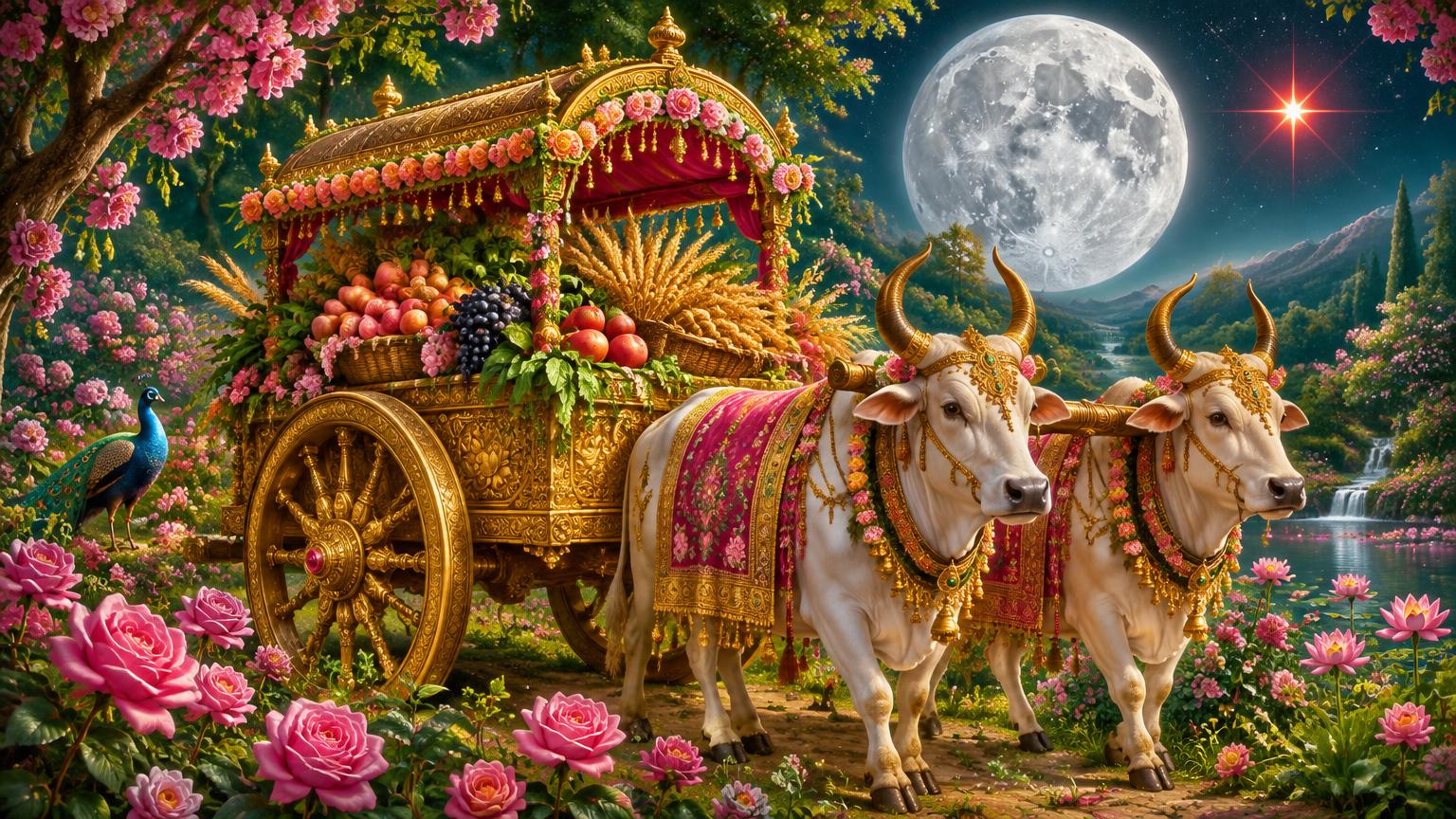
Rohini – the power that gives life form
Rohini is the fourth of the 27 nakshatras, or lunar mansions. It spans 10°00′ to 23°20′ Taurus in the sidereal zodiac. Its planetary ruler is the Moon, while the sign of Taurus is ruled by Venus. This connection brings together emotional responsiveness, sensuality, creativity, and the need for security.
Rohini speaks of growth. Of a seed given soil, water, and time. Of an idea becoming something tangible. Its strength lies not only in the first spark of inspiration, but in the ability to nurture something long enough for it to mature.
Yet all growth needs room. What we try to hold on to at any cost, we may unwittingly restrict. Rohini's central question, then, is not only how to create abundance. It is also how to love it without clinging.
What follows is a symbolic interpretation within Jyotish, or Vedic astrology, not a scientifically validated description of personality or prediction of events.
Essential details
- Number: 4
- Span: 10°00′–23°20′ Taurus
- Nakshatra ruler: the Moon, or Chandra
- Sign ruler: Venus, or Shukra
- Deity: Prajapati, often associated with Brahma
- Main symbol: a cart or ox-drawn wagon
- Other symbol: a growing tree
- Shakti: Rohana shakti, the power of growth
- Element: earth
- Guna: rajas, the quality of activity
- Life motivation: moksha, liberation
- Animal symbol: the snake
The name Rohini is associated with a reddish hue and the imagery of growth. It suggests vitality, awakening, and fertility.
These details are not personality labels. Some classifications differ between traditions. Together, they form a symbolic framework for reflecting on creation, nurturing, and attachment.
Prajapati and the story of Rohini and the Moon
Rohini's deity is Prajapati, lord of creation or living beings. Later interpretations often associate him with Brahma, the creative principle. Here, creation is not simply a sudden flash of inspiration. It is the continuation of life through care, repetition, and the cultivation of conditions that allow development.
Rohini therefore raises the question of a creator's responsibility. Starting something does not necessarily mean knowing how to care for its consequences. A project needs maintenance. A community needs agreements. A relationship needs attention beyond the initial excitement.
In a well-known mythological story, the Moon is married to Daksha's 27 daughters, who represent the nakshatras. Among them, he favors Rohini. The others complain to their father about being neglected. Daksha curses the Moon, who begins to lose his strength.
In one version, Shiva softens the curse. The Moon therefore alternately wanes and waxes. The details vary between sources, but the central theme remains: attraction can upset the balance when it becomes exclusive.
In this story, Rohini is not to blame for someone else's unequal attention. Above all, the myth reveals the responsibility of the one making the choices. It also teaches that privileged status cannot preserve closeness forever. Closeness needs fairness, space, and acceptance of changing rhythms.
The symbols of the cart and the growing tree
The cart brings together movement, carrying capacity, and material life. It transports something from one place to another. A harvest finds its way to people. An idea gains the resources it needs to become useful.
Rohini is therefore more than an image of comfort. It knows how to organize the conditions for progress. It notices what is missing, what needs to be connected, and what needs support. Yet a cart needs direction. Without it, we may keep accumulating more without knowing where we are going.
The growing tree speaks of another aspect of the same power. Roots need stability. The canopy needs space. Fruit needs the right amount of time.
We cannot force a tree to mature. We can, however, care for the conditions around it. This distinction is just as important in relationships. Support helps another person grow. Control demands that they grow according to our vision.
Shakti – the power that allows something to grow
Rohini's traditional power is called Rohana shakti. It is the power of growth, development, and ascent. In symbolic interpretations, it connects plant growth, life-giving waters, and the unfolding of creation.
Its fertility is not limited to biology. It can mean creating a book, a home, a business, a garden, or a dependable working partnership. What matters is that something is given the opportunity to develop.
Rohana shakti often works through small, repeated actions. Regular watering. Attentive listening. Refining a product. Returning to a task even when the initial momentum fades.
Its shadow is the belief that everything must keep growing. More work, more possessions, more response. Yet mature growth also includes pruning and rest. Sometimes, reducing the scope is precisely what makes something stronger.
The Moon in Taurus – feeling, form, and Venus
The Moon represents emotional experience, memory, responsiveness, and the need for security. Taurus seeks tangible support. Venus adds a sense of harmony, pleasure, value, and relationship.
In Jyotish, the Moon is exalted in Taurus. Its exact point of exaltation is at 3° Taurus, which lies outside Rohini. The Moon in Rohini should therefore not be equated with the point of maximum exaltation. Nor does exaltation, in itself, guarantee an easy life.
Symbolically, this combination connects feelings with everyday conditions. A peaceful space, a pleasant meal, or a dependable agreement can mean a great deal. Beauty does not have to mean luxury. It can be the simple feeling that life's needs are well cared for.
The challenge arises when external order becomes the only source of inner security. The Moon changes. Taurus wants permanence. A mature expression therefore builds stable habits while allowing needs to change over time.
Inner world and character
In a symbolic interpretation, a strong Rohini influence may emphasize sensitivity to moods, the quality of a space, and relationships between people. How something sounds, works, or feels in everyday life becomes important.
Its warmth is often practical. It does not stop at good intentions. It prepares a space, attends to a detail, or notices a need that no one has voiced.
A mature expression may include:
- patience in developing ideas,
- a sense of quality and proportion,
- creative imagination,
- dependable care for what is shared,
- enjoyment of simple pleasures,
- the ability to bring people and resources together.
Yet being appealing is not the same as feeling secure within. Someone may seem calm on the outside while inwardly checking whether they still matter. Rohini matures when it no longer measures its worth solely by the response of others.
Rohini's gifts
The ability to nurture
Rohini can recognize what needs time and regular attention. It does not necessarily expect immediate results. This gift emerges in learning, collaboration, and long-term projects. In its mature form, it supports independence rather than dependence.
Creativity with tangible results
Imagination wants to take shape. A feeling can become a piece of writing, an object, a garden, or a well-organized process. What matters is not only that an idea is interesting, but that someone can experience or use it.
A sense of quality
Rohini can sense the difference between surface appeal and good craftsmanship. It notices materials, rhythm, taste, and detail. This sensitivity becomes valuable when it serves to improve an experience rather than encourage comparison.
Persistence in building
Its strength often unfolds gradually. It can return to the same goal and refine what is not yet working. Over time, small improvements come together into something solid.
Creating a welcoming space
It can help people feel welcome. This does not require luxury. Sometimes an attentive question, a clear agreement, and room for differences are enough. Mature hospitality does not leave anyone owing affection in return.
Shadow sides and inner challenges
The gift of nurturing can become excessive interference. The desire for quality can slip into dissatisfaction. Persistence can turn into stubbornness.
Common symbolic challenges include:
- attachment to the familiar, even when it no longer supports growth,
- jealousy when attention seems to be slipping away,
- seeking validation through appearance or possessions,
- putting off an uncomfortable conversation,
- buying comfort instead of resolving a problem,
- offering help with an unspoken expectation of repayment,
- equating change with a loss of security.
The need to hold a special place in another person's life can be particularly sensitive. This need is human. The problem arises when we try to secure that place through checking, comparison, or restriction.
The key question is: Am I nurturing this so it can grow, or so it will remain mine?
Mature Rohini does not reject desire. It learns to express it directly. Closeness then no longer needs hidden tests.
The four padas – four modes of expression
Each pada, or quarter, spans 3°20′ and is associated with a particular navamsha sign, a subdivision used in Jyotish. Rohini's underlying theme remains the same, while its mode of expression changes.
1st pada: 10°00′–13°20′ Taurus · Aries navamsha
The first pada combines growth with an initial surge of energy. Aries adds initiative, competitiveness, and the need to take an independent step. A creative feeling wants to become action quickly. This emphasis may support the courage to show one's work, begin a collaboration, or try a new direction.
The challenge is the tension between patient Taurus and swift Aries. Something begins decisively, but waiting then becomes difficult. Maturity means distinguishing the moment for initiative from the time for nurturing. Not every result arrives at the pace of the original desire.
2nd pada: 13°20′–16°40′ Taurus · Taurus navamsha
The second pada strengthens Rohini's earthy nature. Taurus is present in both the zodiac sign and the navamsha. This placement is called vargottama. Persistence, sensory experience, quality, and the desire for a stable foundation may be emphasized.
The gift is steady building. The challenge is the belief that change threatens everything that has been created. Vargottama does not automatically mean happiness or success. A useful question for this pada is what is truly valuable, and what we preserve mainly because it is familiar.
3rd pada: 16°40′–20°00′ Taurus · Gemini navamsha
The third pada brings language, curiosity, and exchange into the process of growth. An idea develops through conversation, learning, and connecting information. Creativity may take on a storytelling, commercial, or design-oriented dimension. Presenting something clearly and engagingly becomes important.
The challenge is scattered attention. Fresh inspiration may arrive before the previous work is finished. Feelings, too, can get lost in explanations. A mature expression connects flexible thinking with a tangible step. It does not need another option when the one already chosen needs to be carried out.
4th pada: 20°00′–23°20′ Taurus · Cancer navamsha
The fourth pada emphasizes the Moon's nature. Belonging, memory, home, and emotional care come to the foreground. Creation needs a sense of connection. The gift is attention to the small gestures that help others feel seen and included.
The shadow emerges when care becomes protection from every change. The past may carry more weight than present needs. Maturity means creating a home that people are also free to leave. Closeness stays alive when it allows growth to take a different direction.
The Moon in Rohini
A natal Moon in Rohini may symbolically emphasize the need for emotional and everyday reliability. Consistent signs of affection matter. An agreement that holds. A presence that does not depend solely on the mood of the moment.
Security may be built through familiar places, objects, flavors, and habits. These become carriers of memory. Attachment itself is not the problem. The difficulty arises when a change in the external environment shakes a person's entire sense of self-worth.
Love may be expressed through care and concrete actions. Yet the other person may need words, more space, or a different kind of support. It helps to ask rather than simply assume.
The Moon's nakshatra is not the whole personality. The Moon's house, aspects, phase, the position of Venus, the ascendant, and other connections all matter. Even a strong Moon does not remove the need to learn relationship skills or set boundaries.
Relationships and closeness
In relationships, Rohini symbolically seeks warmth, responsiveness, and a sense of shared life. Attraction matters, but it is not enough on its own. Closeness needs actions that are repeated even without a special occasion.
Its care can be generous and attentive. Yet no one can permanently provide the feeling of being chosen. A partner's independence is not necessarily rejection.
Growth in relationships involves three tasks:
- Express your need without testing the other person. Rather than withdrawing or hinting, say what you miss. Others cannot reliably read expectations that remain unspoken.
- Distinguish care from control. Ask whether help is wanted. Closeness does not give you the right to make decisions for someone else.
- Allow different rhythms. One person needs more time together, another more solitude. A difference calls for an agreement, not an automatic conclusion that love is lacking.
The myth of the Moon also reminds us to distribute attention fairly. Affection does not justify neglecting other responsibilities.
Nakshatra compatibility alone does not determine marriage or the longevity of a relationship. Even a broader astrological comparison cannot replace conversation, respect, and the actual behavior of both people.
Work, career, and money
Rohini may symbolically support work in which value develops gradually. Quality, care for materials, user experience, and dependable maintenance are important.
Possible areas of interest include:
- design, art, and crafts,
- food production, gardening, and working with the land,
- hospitality and creating pleasant spaces,
- product development and project management,
- communication, sales, and presenting content,
- education and stewardship of shared resources.
These are not prescribed careers for people with Rohini placements. Career decisions require consideration of abilities, education, circumstances, and interests. In Jyotish, the wider chart is also assessed.
With money, the desire for a reserve may meet the enjoyment of quality. Both can be useful. The difficulty arises when a purchase becomes proof of personal worth.
It helps to distinguish between a need, a pleasure, and spending for status. Creative work also needs a price, a deadline, and a clear scope. Loving a project does not require unlimited investment.
When Rohini works through other grahas
Each graha, or planetary influence in Jyotish, illuminates a different part of the same symbolism.
- The Sun connects identity with creation and visible contribution. The challenge is allowing self-respect to depend on recognition.
- Mercury emphasizes expression, practical learning, and communicating value. It is important that an appealing presentation does not obscure the facts.
- Venus strengthens the aesthetic and relational dimensions. It teaches the distinction between harmony and avoiding an uncomfortable truth.
- Mars brings energy for building and protecting resources. The challenge is defensive stubbornness when feeling threatened.
- Jupiter may expand generosity, teaching, and the development of shared opportunities. It needs moderation in promises and expansion.
- Saturn emphasizes time, limitations, and endurance. Creation requires patience, but effort must not become the only measure of worth.
- Rahu may intensify the hunger for abundance, recognition, or a special experience. The key question is when enough is enough.
- Ketu may open a path away from external validation. The challenge is dismissing simple needs or withdrawing from collaboration.
Rahu and Ketu are lunar nodes, not physical planets. In Jyotish, they are treated as grahas.
These are starting points for interpretation. Their meaning changes with the house, dignity, aspects, and the chart as a whole.
The natal nakshatra, a transit, and a dasha are not the same
The Moon's natal nakshatra is a fixed reference point in the chart. In symbolic interpretation, it describes a way of experiencing life. A transit is a graha's temporary passage through the same region.
The Moon's passage through Rohini is traditionally associated with nurturing, creating, and strengthening. This can be an invitation to care for something important, not a guarantee of a successful day. Jyotish considers other factors as well when choosing an appropriate time.
A Moon dasha, or planetary period, is not the same as the Moon in Rohini. In the Vimshottari system, a natal Moon in Rohini means that life begins in a Moon period. The remaining length of that period depends on the Moon's exact position within the nakshatra.
Events during a dasha are not interpreted through its ruler alone. Natal placements and subperiods also matter. A general description is therefore not a personal prediction of the future.
The spiritual and karmic lesson
Rohini's central lesson is to nurture without possessing.
This does not mean giving up beauty, comfort, or closeness. It means allowing them to exist without demanding complete control. A tree is no less valuable because its appearance changes each year.
Its connection with moksha opens an interesting tension. How is a nakshatra of material growth connected with liberation? Through the experience of attachment itself. A person may discover that a full house does not necessarily provide inner support.
Here, karma is understood as a spiritual framework for reflecting on actions and consequences, not as proof that someone is to blame for their suffering.
The shift is from accumulation to recognizing sufficiency. From the need for a special position to reciprocity. From creating for validation to creating in a way that genuinely nourishes life.
Practical ways to find balance
Nurture one thing consistently
Choose a plant, a skill, or a project. Set a small weekly step. Notice what supports development and what merely adds to the workload. Growth needs attention, not constant pressure.
Enjoy without immediately acquiring
Notice beauty without needing to buy or keep it. Listen to music. Look at a tree. Use an object you already own. Pleasure does not always require a new possession.
Name the need before reacting
Pause when you feel jealousy or disappointment. What is missing: attention, clarity, an agreement, or a sense of inclusion? Then express the need without accusation. The feeling matters, but it is not, by itself, evidence of someone else's intention.
Clarify the boundary between care and responsibility
Before helping, check what the other person wants. Agree on the scope. Leave them their part of the task. Support is more sustainable when it does not rest on guesswork and silent expectations.
Practice small changes
Change an unimportant habit. Give away an object you do not use. Try a different way of carrying out a familiar task. The aim is not to give up security, but to explore how much flexibility you already have.
Keep spiritual practice simple
If it resonates with you, choose quiet contemplation, gratitude, or a traditional prayer to the Moon or the creative principle. This is neither an obligation nor a substitute for professional support. Mantras and gemstones do not have guaranteed effects. A nakshatra alone is not a basis for an expensive purchase or a health decision.
Questions for self-reflection
- What am I nurturing right now, and which of these things genuinely needs my help?
- Where am I confusing security with things staying unchanged?
- Do I measure my worth by the amount of attention I receive?
- Which pleasure enriches me, and which merely postpones an uncomfortable conversation?
- What could I give more space to without giving it up?
Frequently asked questions
Does Rohini guarantee beauty, wealth, or popularity?
No. These are traditional symbolic associations, not guaranteed qualities or outcomes. Appearance, material circumstances, and social responses have many real-world influences. One nakshatra does not determine them.
Is the Moon in Rohini always favorable?
Not in the same sense for everyone. Tradition values this placement, but the house, aspects, lunar phase, and wider chart matter. Even the word “favorable” needs a specific context.
Does Rohini mean jealousy?
No. Attachment is one possible theme of this archetype, not a judgment of personality. Responses are shaped by experience, circumstances, relationships, and conscious choices. Jealousy cannot be inferred from a natal nakshatra.
Why are the padas Aries, Taurus, Gemini, and Cancer?
Because these four successive sections of Rohini correspond to those navamsha signs. They add initiative, stability, exchange, and emotional belonging, respectively. Rohini itself remains entirely within Taurus.
Does a nakshatra determine career, health, marriage, or the future?
No. A nakshatra alone determines none of these areas. Astrological symbolism does not replace medical assessment, career exploration, or decision-making in relationships. It may be useful as a starting point for reflection.
In closing
Rohini is the nakshatra of life taking shape. Its strength lies in attention, repetition, and delight in what slowly matures.
Yet its deepest gift is not simply the ability to create more. It is the ability to recognize what is worth nurturing, and when something has enough support to grow independently.
Mature Rohini does not close off the garden to preserve every flower. It tends the soil. Accepts the seasons. Shares the harvest.
In this way, abundance becomes more than possession. It becomes a way of relating to the world: warm, responsible, and open enough for life to grow beyond its creator's original vision.
Which nakshatra is yours?
Enter your date, time and place of birth — the calculation is free.
Calculate your nakshatra