
Home/Nakshatras/Ashwini
Nakshatra 01 · ruler Ketu
Ashwini
Ashwini
Ashwini carries the light of dawn, swiftness, and the healing power of the divine twins, the Ašvini Kumarja. It encourages the courage to begin anew, practical efficiency, learning, and the ability to bring an idea to life quickly. Its lesson is to channel restless energy with moderation, humility, and conscious care for others.
- Range
- 0°00′ Aries – 13°20′ Aries
- Ruler (dasha period)
- Ketu
- Deity
- Ashwini Kumaras
- Symbol
- Horse's head
- Gana (temperament)
- Deva (divine)
- Keywords
- —
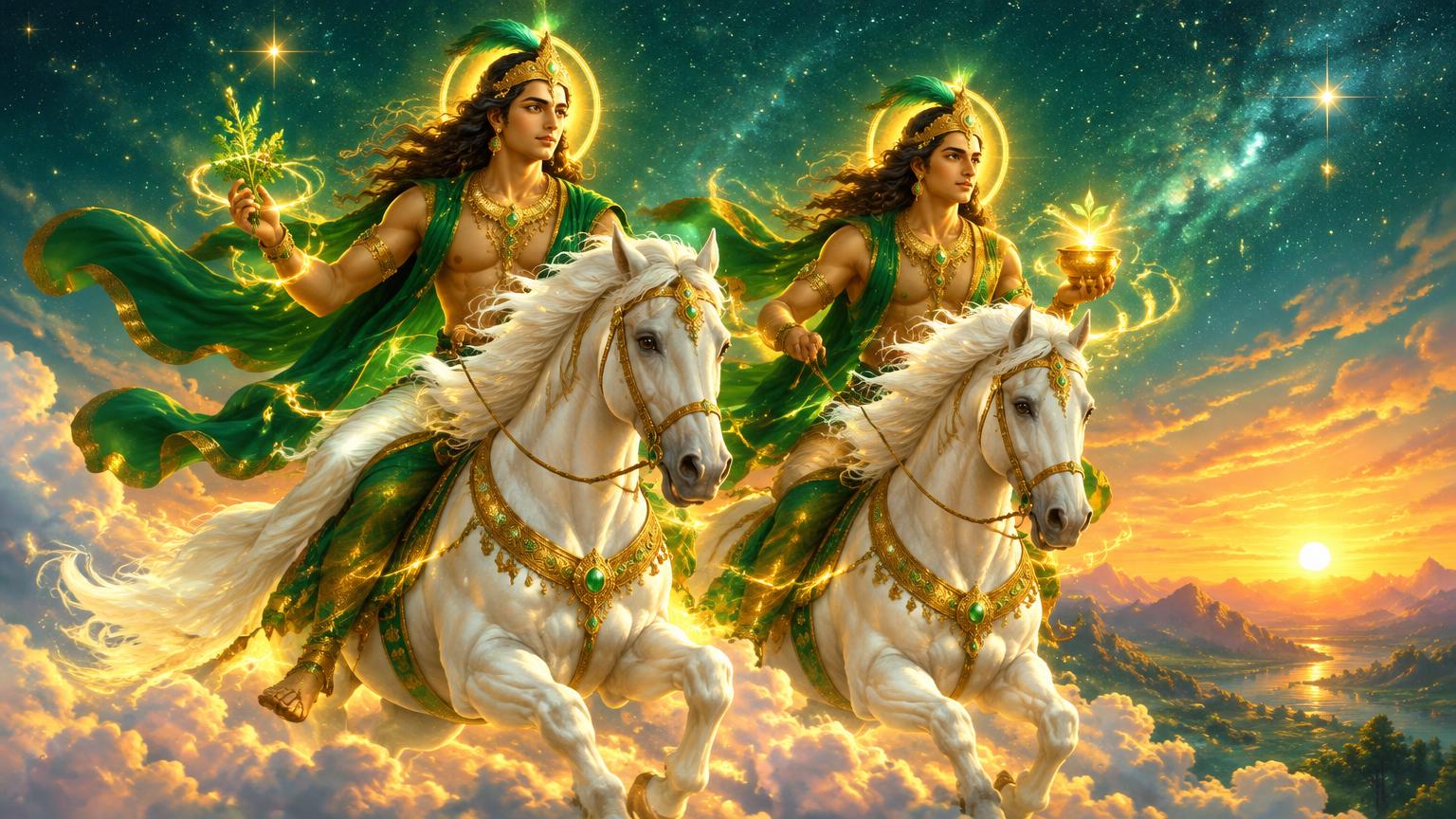
Ašvini – the courage to take the first step
Ašvini is the first of the 27 nakshatras, or lunar mansions. In the sidereal zodiac, it spans 0°00′–13°20′ Aries. It is ruled by Ketu, while Aries is ruled by Mars. Its symbolism brings together beginnings, quick responses, independence and a willingness to help.
Where some nakshatras wait for an experience to mature, Ašvini recognises an open door. It is interested in what can be done now. In a room full of reservations, it may see a simple first step. Its strength is not necessarily a fully developed plan. Often, it is the courage that makes a plan possible in the first place.
But beginning is not the same as finishing. This is precisely where its path of growth opens up. It learns to preserve its vitality without responding to every discomfort by moving on again.
In Jyotish, or Vedic astrology, these are traditional symbolic associations, not scientifically established rules of personality. This description is an invitation to observe. It does not determine anyone’s destiny.
Key details
- Number: 1
- Span: 0°00′–13°20′ Aries
- Nakshatra ruler: Ketu, the south lunar node
- Sign ruler: Mars, also known as Mangala
- Deity: Ašvini Kumara, the divine twins
- Main symbol: a horse’s head
- Shakti: Šighra-vjapani šakti, the power of swift attainment
- Element in the traditional classification of nakshatras: earth
- Guna: rajas, the quality of activity
- Life motivation: dharma, purposeful and responsible action
- Animal symbol: horse
These attributes describe different layers of symbolism. The nakshatra’s earth element therefore does not contradict the fire sign of Aries. The first emphasises tangible realisation; the second, initiative and momentum.
Ašvini Kumara – the twins who rush to help
The deities of Ašvini are Ašvini Kumara, often called Nasatja and Dasra. In Vedic tradition, they are associated with dawn, travel, rescue from hardship and healing knowledge. Their presence heralds the transition from night into a new day.
In one account, they are connected with the Sun and Saranju, who takes the form of a horse. The horse is therefore not merely a later embellishment of their symbolism. It belongs to the very origin of the story.
Another well-known account describes the sage Čjavana. The twins help restore his youth. We can read the myth as an image of renewed engagement with life. Something weary finds the possibility of movement again.
These are not promises of health benefits. The stories speak in the language of symbols. In everyday terms, they highlight timely help, skill and the ability to recognise a solution.
Their dual nature matters too. Ašvini is not simply a lone hero. Its divine image includes cooperation. A swift response becomes more effective when different abilities come together.
The symbol of the horse’s head
The horse’s head brings together alertness, a sense of direction and readiness to move. A horse responds to its surroundings with its whole body. It does not always need a lengthy explanation to detect a change.
Similarly, Ašvini’s symbolism emphasises direct perception. A person may quickly sense where an opportunity is opening up. They like to try things, test them and adjust their direction through experience.
A horse also needs a relationship with the reins. Too little guidance leads to scattered movement. Too much control stifles natural agility. Balance is not about force, but clear direction.
In practical life, this image asks: where am I directing my energy? Speed without a destination can be exhausting. A worthwhile destination, however, gives meaning even to a small step.
Shakti – the power of swift attainment
Ašvini’s traditional power is Šighra-vjapani šakti. It is usually understood as the power of swift attainment, or of reaching a goal quickly.
The emphasis is not simply on haste. It is about a short path between recognising a need and responding appropriately. Someone notices that information is missing and obtains it. Someone else connects people who can resolve a standstill together.
A mature expression of this power removes unnecessary detours. It does not, however, bypass checks, permission or professional boundaries. In complex decisions, pausing may be the most appropriate next step.
The shadow of this shakti emerges when speed becomes a measure of personal worth. A person may then struggle to accept processes that need time. Ašvini therefore learns to distinguish between timeliness and haste.
Ketu in Aries – the inner impulse and Mars’s direction
Ašvini combines Ketu’s rulership of the nakshatra with Mars’s rulership of Aries. This does not mean that everyone with a strong Ašvini influence also has natal Ketu in Aries.
In traditional interpretation, Ketu represents detachment, familiar patterns and knowledge that is not always put into words. Mars represents will, action, courage and setting boundaries.
Together, they can symbolise a response that comes before an explanation. A person acts first and only afterwards explains why. This directness can be valuable. Yet inner certainty is not proof of being right.
Tension arises between the desire for immediate experience and a tendency to lose interest quickly. Mars wants to achieve the goal. Ketu may ask why one should become attached to it at all.
Maturity means examining the impulse and then accepting responsibility. It is not about suppressing initiative. It is about choosing an action we can still stand behind later.
Inner world and character
A strong Ašvini influence may appear as a sense of inner readiness. A person wants to have room to move. Prolonged uncertainty may weigh on them more heavily than a demanding but clearly defined task.
Sometimes, they first experience emotions as a need to act. When sad, they begin putting things in order. When uncertain, they look for a new possibility. This can be useful, as long as activity does not replace contact with the feeling itself.
A mature expression includes:
- curiosity about the unknown,
- a direct and lively response,
- independent initiative,
- a willingness to learn by trying,
- practical help without unnecessary displays.
Beneath the visible drive, there may also be sensitivity to restriction. It therefore helps to distinguish between a protective boundary and control that genuinely takes away freedom.
The gifts of Ašvini
The courage to begin
Ašvini can break through the standstill created by overthinking. It does not always need complete certainty. A reasonable chance that something is worth trying may be enough.
This gift becomes useful when the first step remains proportionate to the risk. Instead of a grand promise, there is a small trial. Courage then takes a form that others can learn from too.
Timely, practical help
This archetype quickly notices when someone needs a lift, information or an extra pair of hands. Its help is tangible. It goes beyond expressing sympathy.
The quality of that help grows by asking what is actually needed. Listening to the answer avoids imposing unwanted solutions. Speed then supports the other person’s dignity rather than overriding it.
Learning through experience
Ašvini can quickly grasp the basics when given the chance to try something. Direct engagement with a task tells it more than lengthy preparation without practical application.
This is not a substitute for knowledge. It is a way into it. The best results come when an attempt is followed by feedback, adjustment and repetition. Initial aptitude gradually becomes reliable competence.
Finding a simple way forward
Where others become entangled in too many possibilities, Ašvini may recognise the essential action. It asks what needs to be done first. In doing so, it restores the group’s sense that progress is possible.
This gift is not about oversimplifying every problem. It means distinguishing the core from the extras. With complex questions, it needs to work with people who check the details and the long-term consequences of the proposed solution.
Rekindling momentum
After an unsuccessful attempt, Ašvini can sometimes reopen a possibility. It does not want one experience to close off the entire future. This is its revitalising quality.
A mature expression does not deny disappointment. It first acknowledges what did not work. Then it looks for something that can still be done. Hope becomes active, but not blind.
Shadow sides and inner challenges
The same speed that opens a door can skip an important conversation. Independence can turn into a refusal of support. A willingness to help can become the belief that one knows best what another person needs.
Common challenges include:
- starting several tasks without finishing them,
- impatience with a slower pace,
- promises made in the first rush of enthusiasm,
- mistaking restlessness for intuition,
- withdrawing when a relationship or work requires perseverance,
- helping without first asking for consent.
The central question is: Am I moving forward because I have a clear direction, or because I find it difficult to stay with my present experience?
The adjustment is not to slow down permanently. What is needed is flexibility. Sometimes a decisive move is appropriate. At other times, it is listening, checking or finishing something uninteresting.
Four padas – four forms of the initial impulse
Each pada, or quarter, spans 3°20′. The navamsha adds a particular mode of expression to the underlying symbolism. The ranges below follow one another without overlap: the exact starting degree of the next pada already belongs to that pada.
1st pada: 0°00′–3°20′ Aries · Aries navamsha
The first pada further emphasises the directness of Mars. The initial impulse wants to become action immediately. Independence, competitive drive and a willingness to take the initiative may come to the fore. This placement is vargottama by sign, meaning that both the rashi, or zodiac sign, and the navamsha are in Aries.
The gift is a clear beginning without unnecessary hesitation. The challenge is judging too quickly. A brief check of intention and consequences is helpful. Vargottama does not automatically mean success or favourable results. The graha, or planetary influence, its strength and the whole chart remain important.
2nd pada: 3°20′–6°40′ Aries · Taurus navamsha
The second pada connects momentum with Venus’s need for value, pleasure and tangible results. A beginning wants to become something useful. Sensory experience, the quality of a product and a sense of material security receive more attention.
The gift is the ability to give an initiative a gradually firmer foundation. The challenge arises between the desire for novelty and attachment to comfort. A mature expression knows how to invest in growth without unnecessary spending. It also learns that a good idea needs care after the first enthusiasm has passed.
3rd pada: 6°40′–10°00′ Aries · Gemini navamsha
The third pada directs speed into Mercury’s world of language, exchange and connections. Curiosity may open several paths at once. Questions, brief experiments, communication and connecting information from different settings become important.
The gift is flexible thinking. The challenges are scattered attention, premature conclusions or speaking before listening. Writing down one main task helps. Skill with information matures when a person checks the source and distinguishes an interesting possibility from a sufficiently supported conclusion.
4th pada: 10°00′–13°20′ Aries · Cancer navamsha
The fourth pada adds the Moon’s sensitivity to security, belonging and mood. Initiative may awaken in response to the needs of loved ones. A quick response takes on a more protective and emotionally coloured form.
The gift is warm, practical care. The challenge is acting out of concern before the other person has expressed what they need. It helps to ask whether help is needed, or simply presence. Emotional closeness becomes safer when caring does not turn into making decisions for someone else.
The Moon in Ašvini
In traditional interpretation, the natal Moon in Ašvini emphasises a need for freshness, responsiveness and room for independent initiative. A sense of security may grow when there is a clear next step.
The emotional response may be quick. This does not mean that the feeling has also been fully processed. Outwardly, a person may already have moved on while still carrying unresolved disappointment within.
It helps to name the feeling before making a decision. “I am angry” is not the same as “I have to leave.” “I am bored” does not necessarily mean that a relationship has run its course.
The Moon’s nakshatra is only one part of the interpretation. The Moon’s house, its connections with other grahas and the placements of Ketu and Mars must also be considered. Actual life experiences matter too.
Relationships and closeness
Ašvini can bring playfulness, directness and a willingness to share experiences into relationships. It likes to show affection through action. It suggests meeting up, helps with a task or opens a conversation.
Difficulty arises when initial momentum becomes the only measure of connection. A quieter phase does not necessarily mean that love has faded. It may be the space in which trust develops.
Three relationship tasks are:
- Ask before acting. A partner is not a problem to be solved.
- Communicate the need for space. Independence does not require disappearing without notice.
- Stay with a difficult conversation. Discomfort alone is not a reason to break off contact.
Compatibility cannot be determined from a single nakshatra. An astrological comparison also requires the wider chart. In a real relationship, however, respect, safety, communication and the actions of both people are decisive.
Work, career and money
Ašvini’s symbolism is associated with tasks that require initiative, mobility and a quick, practical response. It may be useful when launching projects, testing solutions or removing initial obstacles.
Possible areas of interest include:
- new product development and entrepreneurship,
- logistics, transport and fieldwork,
- sport and teaching practical skills,
- technical support and rapid troubleshooting,
- work in emergency services with the appropriate professional qualifications,
- event organisation and project coordination.
A nakshatra does not determine a profession or competence. Choices are shaped by knowledge, opportunities, circumstances and personal values. Even within Jyotish, the wider chart is assessed.
With money, it helps to draw a line between experimenting and taking risks. Set a budget for a new idea. Let a larger purchase wait until you have reviewed it again. Enthusiasm is a good starting point for research, not a sufficient financial plan.
When Ašvini works through other grahas
The graha shows which function of life takes on the tone of the nakshatra.
- Sun: identity may develop through initiative; the challenge is constantly proving independence.
- Mercury: supports quick connections between ideas; details need to be checked.
- Venus: emphasises freshness in relationships and creativity; it learns to value what lasts.
- Mars: intensifies direct action; assessing risk and respecting boundaries are important.
- Jupiter: may connect courage with learning; care is needed to avoid excessive promises.
- Saturn: brings out the tension between speed and gradual progress; perseverance can strengthen initiative.
- Rahu: may intensify the desire for novelty; realistic measures of success are needed.
- Ketu: emphasises non-attachment and direct insight; the challenge is disengaging too soon.
These are symbolic starting points. House placement, dignity, aspects and other connections can substantially change how they are expressed.
A natal nakshatra, a transit and a dasha are not the same
The Moon’s natal nakshatra is its placement at birth. In traditional interpretation, it describes recurring themes in experience. It does not mean feeling the same way every day.
A transit is the current passage of a graha. The Moon moves through Ašvini in approximately one day. This is not a guarantee that every such day will be favourable for a new beginning.
A dasha is a period in a particular astrological timing system. In Vimshottari dasha, a natal Moon in Ašvini means beginning life with the remaining portion of Ketu’s period. The length remaining at birth depends on the Moon’s exact position.
Ketu’s dasha is not the same as the Moon in Ašvini. Ketu’s natal placement is also assessed. None of these labels, on its own, predicts a specific event.
The spiritual and karmic lesson
Ašvini’s central lesson is to act at the right time and remain responsible for what follows.
The initial impulse is valuable. But not every impulse is inner guidance. Discernment requires contact with facts, physical limits and consequences.
Karmic language can be understood as a description of recurring responses. A person starts something, leaves at the first sign of resistance and seeks another fresh beginning. Change happens when they first explore that resistance instead of automatically bypassing it.
Dharma here does not demand constant heroism. Sometimes it means handing a task over to someone better qualified. At other times, it means admitting a mistake or keeping one’s word. Freedom matures when it also includes conscious commitment.
Practical ways to find balance
Introduce a brief pause
Before a non-urgent decision, take three normal breaths. Name your intention, the risk and the next step. In a genuine emergency, follow the appropriate safety procedures.
Write down the smallest possible trial
Reduce a new idea to a manageable experiment. Define the time, cost and measure you will use to assess the result. Only then expand the plan.
Finish something every day
Choose one small unfinished task. Complete it before starting a new one. This lets you practise following through without having to give up curiosity.
Ask what kind of support is wanted
Use the question: “Would you like me to listen, offer a suggestion or give practical help?” Then respect the answer. Declining help is also an acceptable response.
Separate the feeling from the command
Write on paper: “I feel …” and then: “I choose …” Leave some space between the two. An emotion is important information, but it is not automatically an instruction.
Plan when to stop, too
When you feel a surge of momentum at work, set a finishing time and decide when you will continue. A break should not be a reward you earn only after exhaustion.
Review your promises
Once a week, review your commitments. What will you fulfil? What do you need to renegotiate in good time? Reliability also grows through honestly revising promises that were too ambitious.
Questions for self-reflection
- Which beginning genuinely calls to me, and which merely distracts me from discomfort?
- Where does speed support quality, and where does it reduce it?
- Before helping, do I check what the other person needs?
- Which unfinished task needs my consistency?
- How can I preserve my independence while also honouring an agreement?
Frequently asked questions
Does Ašvini always mean impulsiveness?
No. Directness is one of its symbolic themes. It can also be expressed as thoughtful decisiveness. Many personal and life factors shape how someone responds.
Does Ašvini indicate healing abilities?
There is a mythological association. It does not, however, establish an ability to diagnose or treat illness. Healthcare work requires appropriate education, training and respect for professional boundaries.
Does a nakshatra determine health, marriage or the future?
No. Such conclusions cannot be justified from a single nakshatra. Even a comprehensive astrological interpretation is not a reliable method for predicting health or other life outcomes.
Why does the pada matter?
The pada distinguishes four shades of the same archetype. In Ašvini, they are connected with Aries, Taurus, Gemini and Cancer. The interpretation also depends on the graha placed there.
How can I check whether my Moon is in Ašvini?
You need your date of birth, a sufficiently accurate birth time and your birthplace, as well as a sidereal calculation with the ayanamsha specified. The ayanamsha is the offset used to align the tropical and sidereal zodiacs. Near a boundary, an uncertain birth time or a different ayanamsha can change the classification.
In closing
Ašvini represents the moment when possibility becomes action. Its value lies in a lively response, courage and a willingness to set something in motion.
But the right direction is not measured by speed alone. It is also measured by listening, checking and remaining true to what we have begun.
A mature Ašvini does not lose its spark. It learns to direct it. It knows when to step forward, when to ask and when to stay. The first step is then no longer just a burst of enthusiasm. It becomes the beginning of a path that can be followed responsibly.
Which nakshatra is yours?
Enter your date, time and place of birth — the calculation is free.
Calculate your nakshatra