
Home/Nakshatras/Vishakha
Nakshatra 16 · ruler Jupiter
Vishakha
Vishakha
Vishakha is the star of purpose, determination, and ripening rewards, associated with Indra and Agni. It brings discipline, persuasive speech, enterprise, and the strength to nurture a chosen goal until it bears fruit. Its energy becomes most creative when ambition is guided by meaning rather than comparison, and when directness is accompanied by tact and respect for others.
- Range
- 20°00′ Libra – 3°20′ Scorpio
- Ruler (dasha period)
- Jupiter
- Deity
- Indra and Agni
- Symbol
- Triumphal arch
- Gana (temperament)
- Rakshasa (fierce)
- Keywords
- —
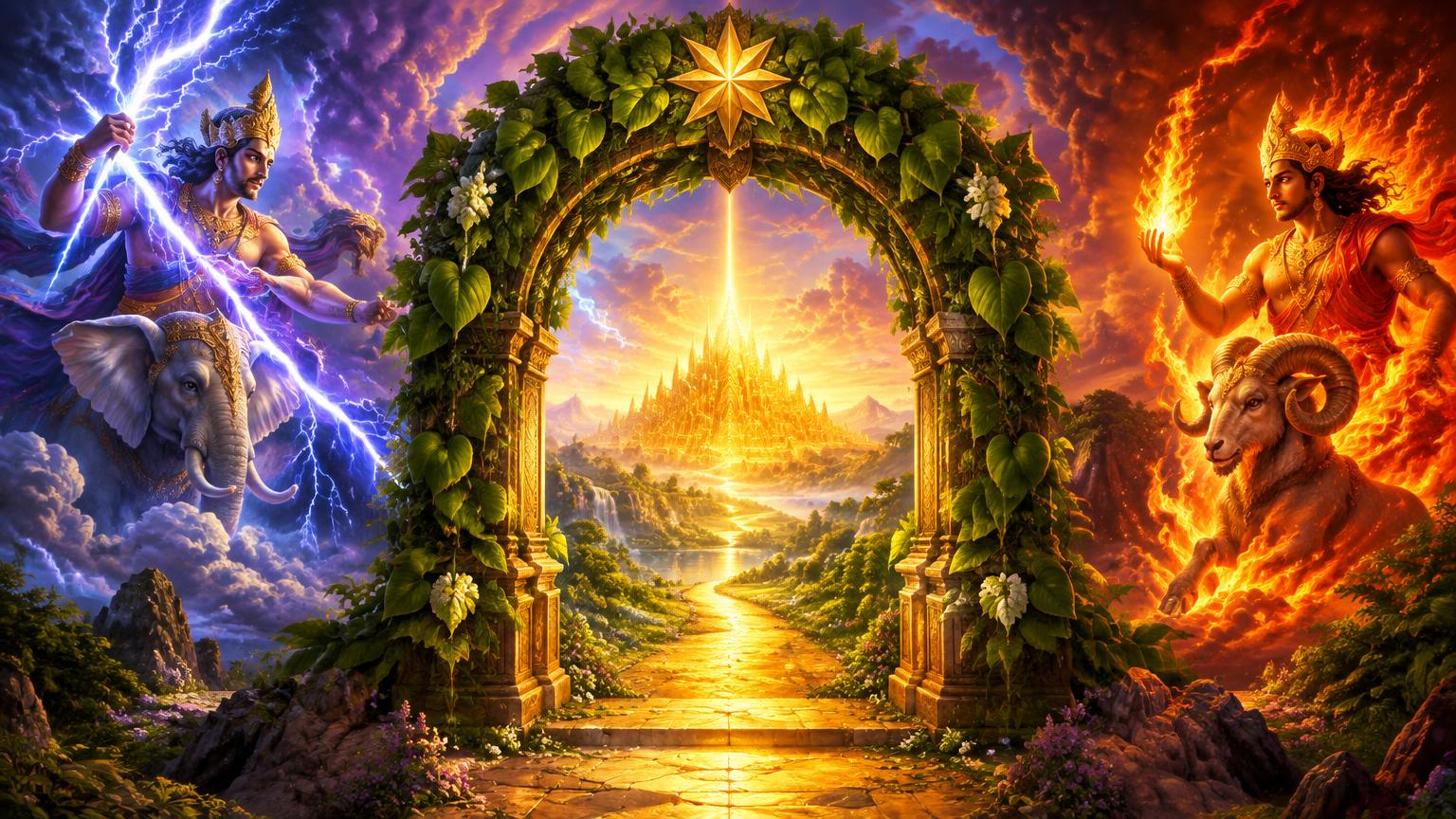
Višaka – a goal that needs the right fire
Višaka is the sixteenth of the 27 nakshatras, or lunar mansions. It spans 20°00′ Libra to 3°20′ Scorpio. Its planetary ruler is Jupiter, and its deities are Indra and Agni. At its heart, vision, effort and the power of transformation meet.
This is the nakshatra of focused desire. Possibility alone does not satisfy it. It wants to develop something, achieve something and experience the fruits of its work. Its question is not simply what you want. It also asks how much of yourself you are willing to invest in your chosen direction.
Višaka can symbolise exceptional perseverance. Yet its deeper purpose is not the endless conquest of new heights. It teaches us to distinguish between a goal that enriches life and one that becomes a substitute for an inner sense of worth.
Essential information
- Number: 16
- Span: 20°00′ Libra–3°20′ Scorpio
- Nakshatra ruler: Jupiter, or Guru
- Sign rulers: Venus in Libra, Mars in Scorpio
- Deities: Indra and Agni, also known together as Indragni
- Main symbol: a triumphal arch
- Other symbol: a potter’s wheel
- Shakti: Vyapana shakti, the power to attain many different fruits
- Life motivation: dharma, a meaningful and responsible direction
- Gana: rakshasa
- Animal symbol: tiger
- Padas, or navamshas: Aries, Taurus, Gemini, Cancer
The term rakshasa is a traditional symbolic classification. It does not imply bad character. These details belong to astrological tradition, not to scientifically validated measures of personality.
Indra and Agni – authority and fire
Višaka is ruled by Indra and Agni, who are also addressed together in Vedic hymns. Indra represents the power to act, leadership and the overcoming of obstacles. Agni is the fire that transforms an offering and connects the human world with the divine.
In a well-known Vedic myth, Indra defeats Vritra, who holds back the waters, and releases their flow. The image of a breakthrough is important to understanding Višaka. Something that was held back becomes accessible again. Courage is needed, but so is a clear direction.
Agni adds another dimension. Overcoming external obstacles is not enough. The inner fire must also be sustained. This fire may represent learning, practice, honesty or a willingness to let go of an ineffective way of working.
Their collaboration can be read as a meeting of ambition and devotion. Indra asks: What do you want to achieve? Agni asks: What must you transform within yourself for that achievement to have value?
This is a symbolic interpretation, not a literal account of an individual’s destiny. A mature expression of Višaka needs both forces. Without Indra, it may never move beyond intention. Without Agni, it may reach its goal but lose touch with its purpose along the way.
The triumphal arch and the potter’s wheel
The triumphal arch marks arrival, victory and the passage into a new chapter. It highlights the moment when effort becomes visible. Višaka therefore often raises questions about recognition, achievement and the right to take our place.
Yet a triumphal arch is a passage, not a dwelling. We cannot stay beneath it forever. If we live only for the next recognition, every success quickly loses its flavour. This creates a hunger that no victory can satisfy.
The potter’s wheel reveals another side of the same process. A vessel takes shape through repetition, balanced pressure and a feeling for the centre. Too much force distorts it. Too little attention prevents it from taking a clear form.
The two symbols complement each other. The arch shows the result. The wheel shows the daily work. Višaka matures when it stops admiring only the finished form and begins to respect the repetition, adjustments and gradual shaping as well.
Shakti – the power for effort to bear fruit
Višaka’s traditional power is Vyapana shakti. It describes the ability to attain many different fruits. Behind it lies the image of cultivating the soil and gathering the harvest. Results emerge from a process, not from strong desire alone.
This shakti is not a promise of wealth or guaranteed success. It speaks of the symbolic connection between focus, the work invested and the unfolding of consequences. Some things need more time than we would like.
In practice, this means choosing a direction, preparing the conditions and reviewing progress regularly. Learning a language, for example, requires more than enthusiasm for travel. It needs continued contact with the language even when the initial momentum fades.
The shadow of this power is impatience with a natural rhythm. We begin checking the harvest before the plant has even taken root. A mature expression of Višaka distinguishes between active effort and forcing a result that is not yet ready.
Jupiter from Libra into Scorpio
Jupiter rules all of Višaka, even though the nakshatra crosses the boundary between two signs. This does not mean that natal Jupiter must be in Libra or Scorpio. It refers to rulership of the nakshatra, not to Jupiter’s actual placement.
Jupiter brings expansion, meaning, knowledge and beliefs. Višaka therefore often needs a reason that makes a goal worth the effort. Achievement alone is not enough. The story that justifies it becomes important.
In Libra, this tendency meets the themes of Venus. Relationships, agreements, social standards and presentation come into focus. We learn to reach a goal through cooperation, not through personal power alone.
In Scorpio, Mars takes on a greater role. Attention turns towards trust, inner strength, hidden motives and a willingness to change. The goal becomes more personal and emotionally intense.
Jupiter’s shadow is an excessive conviction that we are right. Višaka therefore needs to ask: Does my goal truly serve a meaningful purpose, or does it simply confirm what I believe about myself?
Inner life and character
A strong Višaka influence can symbolise someone who finds it difficult to live without direction. When they sense a meaningful goal, they focus. They are willing to practise, explore and try again where other people’s initial enthusiasm has already faded.
Outwardly, they may be sociable and adaptable. Inwardly, however, they pay close attention to where their life is heading. They notice discrepancies between promises and results. Unfinished matters may occupy their thoughts for a long time.
Common qualities of a mature expression include:
- focus when facing an important task,
- perseverance even without immediate recognition,
- the ability to bring people together around a shared goal,
- an interest in knowledge and a broader sense of meaning,
- a willingness to improve,
- courage to navigate a more demanding transition.
Not everyone with Višaka will necessarily have all these qualities. Its expression depends on the graha, or planetary factor, the house, the sign and other connections in the chart. Life circumstances and personal choices also matter.
The gifts of Višaka
Focus
Višaka can direct considerable energy towards a single task. This gift emerges when it selects what matters most from a wealth of possibilities and gives it time. Less distraction creates more room for genuine depth.
Perseverance
An initial failure does not have to mean the end of the road. This symbolism supports returning to the work, adjusting the approach and learning from experience. Perseverance is most useful when it remains connected to sound judgement.
Bringing people together
Indra’s leadership dimension can help establish a shared direction. A person may know how to explain why a task matters and bring different abilities together. Mature leadership also shares the recognition.
A sense of potential
The potter’s wheel speaks of recognising potential. Višaka may see clearly what an idea could become. Rather than stopping at its current form, it looks for a feasible next step.
The search for meaning
Jupiter encourages questions about values and purpose. This gift allows ambition to grow beyond personal prestige. An achievement can become a contribution to knowledge, community or the quality of our shared life.
Each of these gifts needs balance. Focus without rest becomes pressure. Leadership without listening becomes imposition.
Shadow sides and inner challenges
Višaka’s greatest challenge is confusing having a goal with being worthy only because of an achievement. When the two merge, rest brings guilt. Someone else’s success may feel like a personal defeat.
Common shadow expressions include:
- comparing your own path with other people’s results,
- persisting out of pride even when the goal no longer makes sense,
- using relationships primarily to support ambition,
- impatience with slower colleagues,
- believing that good intentions justify harmful means,
- a sense of emptiness immediately after reaching a goal,
- taking on too many commitments for fear of missing opportunities.
The answer is not to give up desire. What is needed is a different relationship with it. Let a goal guide your actions, rather than define your entire identity.
A simple check-in can help: What does this path give me? What does it take away? Would I choose it even without an audience? The answers can reveal where the fire is still alive and where only the habit of proving yourself remains.
Four padas – four ways of expressing Višaka
Each pada, or quarter, spans 3°20′. The first three are in Libra and the fourth is in Scorpio. Their navamshas are Aries, Taurus, Gemini and Cancer. A navamsha adds a layer of interpretation; it does not replace the sign or the chart as a whole.
1st pada: 20°00′–23°20′ Libra · Aries navamsha
The first pada, with its Mars-ruled navamsha, emphasises initiative, competitiveness and the need to make an independent move. Libra wants to consider others, while Aries wants to begin. This can describe someone who knows how to raise an issue, launch a project or clearly represent a shared interest.
The gift is courageous cooperation. The challenge is moving faster than agreement allows. A person may invite others into a project, then struggle to accept a different way of working. Defining responsibilities at the outset can help. Initiative becomes more mature when there is also room for others to respond.
2nd pada: 23°20′–26°40′ Libra · Taurus navamsha
The second pada, with its Venus-ruled navamsha, emphasises stability, quality and tangible results. Ambition wants to take a lasting form. An orderly environment, reliable relationships, a good product or work whose value is clearly recognisable may be important.
The gift is patiently creating value. The challenge arises when security becomes dependent on possessions, status or constant reassurance that an achievement is impressive. A mature expression can enjoy what has been created without needing to keep expanding it. Distinguishing between genuine need, comfort and comparison with others can help.
3rd pada: 26°40′–30°00′ Libra · Gemini navamsha
The third pada, with its Mercury-ruled navamsha, directs energy towards language, learning, networking and the exchange of ideas. A goal may develop through writing, teaching, negotiation or bringing different pieces of information together. A particular strength is the ability to adapt an explanation to the person listening.
The challenge is scattered attention. An interesting new possibility may interrupt work just before it is finished. Words can also become a substitute for action. It helps to establish a clear outcome for a conversation: a decision, a written record, a deadline or a division of tasks. Communication then becomes not merely lively, but useful.
4th pada: 0°00′–3°20′ Scorpio · Cancer navamsha
The fourth pada combines a Mars-ruled sign with a Moon-ruled navamsha. Goal-oriented energy takes on a stronger emotional foundation. Belonging, protection, trust and the feeling that effort is safeguarding something precious become important. Behind the ambition may lie a desire for a safe space.
The gift is dedication with sensitivity to people. The challenge is entangling closeness with control, or success with emotional security. A person learns to name what they fear rather than demand an absolute guarantee. A boundary does not mean rejection, and another person’s independence is not evidence of a lack of love.
The Moon in Višaka
A natal Moon in Višaka may indicate an emotional need for direction and progress. A person may find it easier to feel settled within when they know where they are directing their energy. A long period without a clear goal may feel uncomfortable.
They may seek security through learning, belonging to a meaningful project or a sense that something is developing. It is important that they also learn to recognise the value of a day in which they have proved nothing.
The Moon in the Libra portion and the Moon in the Scorpio portion do not express themselves in quite the same way. In Scorpio, the Moon is traditionally in its sign of debilitation, with the deepest point at 3°. This is a technical concept in Jyotish, or Vedic astrology, not a diagnosis or a prediction of misfortune.
A personal interpretation requires the house, aspects, sign ruler, Jupiter and the whole chart. The Moon’s nakshatra alone cannot tell us how emotionally mature someone is or how they will live.
Relationships and closeness
Višaka can bring commitment, enthusiasm and a desire for shared growth into a relationship. There is an appeal in the feeling that two people are building something together. A shared direction can create connection, but it must not become the only reason for closeness.
Difficulty arises when the relationship becomes a self-improvement project. The other person does not always need a plan, advice or encouragement to progress. Sometimes they simply need to be heard without having their performance assessed.
Three important relationship tasks are:
- Listen without immediately trying to fix things. First check whether the other person wants a solution or your presence.
- Respect different goals. Closeness does not require the same pace, profession or idea of success.
- Remain honest when competition arises. Say when you feel envious or overlooked without turning it into an accusation.
Compatibility does not depend on a single nakshatra. Even an astrological comparison requires both charts, while the actual relationship is shaped by communication, boundaries, life circumstances and the actions of both people. A shared goal is no substitute for mutual respect.
Work, career and money
Višaka’s symbolism may find expression in work that requires focus, development and perseverance through several stages. The useful question is not only which profession suits it. It also matters what way of working allows ambition to be used maturely.
Possible areas of interest include:
- project management and organisational development,
- entrepreneurship and product design,
- law, negotiation and advocacy,
- teaching, mentoring and research,
- communication, sales and strategic planning,
- design and craftwork.
These are not career predictions. An astrological assessment considers the tenth house, its ruler, associated grahas and dasha periods. Real-life choices also depend on abilities, education, opportunities and interests.
With money, it is useful to distinguish growth from proving your status. A higher income does not necessarily mean greater security if commitments grow alongside it.
A clear budget, a reserve and a predetermined risk limit offer practical support. Astrological symbolism is not a basis for an investment decision or a guarantee of returns. Even a highly appealing goal needs a realistic calculation.
When Višaka works through other grahas
Each graha uses the same symbolic space differently.
- The Sun may seek identity through achievement and leadership. The task is to distinguish dignity from applause.
- Mercury emphasises persuasion, learning and planning. It needs fact-checking, not just a good argument.
- Venus connects the desire for growth with relationships, beauty or comfort. Closeness must not become a trophy.
- Mars strengthens initiative and persistence. It is important to distinguish determination from unnecessary conflict.
- Jupiter emphasises meaning, teaching and beliefs. Openness to correction protects against dogmatism.
- Saturn may bring the gradual building of results over a long period. The challenge is valuing yourself solely through productivity.
- Rahu may increase the hunger for success and unconventional paths. Ethics and verifiable limits are needed.
- Ketu may prompt a withdrawal from external recognition. The task is to find meaning without devaluing everyday work.
These are interpretive possibilities, not definitive judgements of personality. The graha’s sign, house, dignity and connections can substantially change its expression.
Natal placement, transit and dasha are not the same
A natal placement means that a particular graha or the ascendant was in Višaka at birth. In the symbolic language of the chart, it describes a more enduring theme. The Moon speaks primarily of subjective experience, Mercury of thinking, and the other grahas of their respective areas.
A transit is a graha’s current passage through Višaka. The Moon crosses this region in approximately one day; slower grahas take longer. A brief passage does not create a new personality or guarantee an event. We can use it as a symbolic prompt to review our goals.
A dasha is a planetary period. In the Vimshottari system, a natal Moon in Višaka means that life begins with the remaining portion of Jupiter’s dasha. Its full duration is 16 years, while the portion remaining at birth depends on the Moon’s exact position.
Jupiter’s dasha is not the same as Jupiter in Višaka. Interpretation takes into account its actual placement, houses, connections and subperiods. None of these layers writes the entire future on its own. Confusing them can quickly produce overly confident predictions.
The spiritual and karmic lesson
Višaka’s central lesson is to desire deeply without losing your freedom to your own desire.
Karma here is not a punishment for ambition. We can understand it as the repetition of actions and consequences. If we respond to every feeling of insecurity with a new achievement, we reinforce dependence on validation. If we pause and examine our purpose, we open up another possibility.
Dharma directs power towards responsible action. It asks not only whether we can win, but how we will act along the way and what our achievement will mean to others.
Spiritual maturity therefore does not require us to abandon our goals. It requires a willingness to revise them. Sometimes the true victory is to continue despite resistance. At other times, it is to admit that the chosen direction is no longer honest or alive.
Practical ways to find balance
Choose one priority
Choose one thing that truly matters for the coming week. Break it into small steps. Write your other good ideas on a separate list so they do not interrupt every process you have begun.
Define what enough means
Before you begin, define what completion will look like. How much time, money or revision makes sense? A clear limit prevents the goal from moving further away each time you make progress.
Review the cost of your goal
Once a week, review how your efforts affect your time, relationships and everyday responsibilities. Do not ask only whether you are making progress. Ask whether you can responsibly sustain this way of working.
Practise working without an audience
Choose an activity you will not immediately show or publish. Write, design, garden or learn. Notice the difference between satisfaction in the process and the desire for a response from others.
Listen without a plan
In one conversation, consciously set advice aside. Ask a question and wait for the answer. Do not turn the person you are speaking with into a task. This is a way to practise closeness that does not depend on a shared achievement.
Create a ritual for checking your intention
Pause for a minute before you begin work. Name your goal, your reason for it and one ethical boundary. If spiritual practice feels natural to you, add a prayer or an expression of gratitude. The ritual is not a guarantee of success, but a reminder to choose consciously.
Questions for self-reflection
- Which goal would I choose even without praise or recognition?
- Where am I persevering out of dedication, and where only out of pride?
- What does enough mean to me before I begin looking for more?
- Do I allow the people around me a different pace and different desires?
- Which value do I want to preserve, even if it means progressing more slowly?
Frequently asked questions
Does Višaka guarantee success?
No. It symbolises effort, direction and the ripening of results. Outcomes depend on many factors, including circumstances and decisions. A nakshatra is not a guarantee of wealth, influence or recognition.
Are the Libra and Scorpio portions the same?
Not entirely. They share Jupiter and the core symbolism. Libra adds Venus’s emphasis on relationships and agreements. Scorpio adds Mars’s intensity, along with questions of trust and inner change.
Does the Moon in the fourth pada mean difficulties?
Not in itself. The Moon’s traditional dignity in Scorpio is only one factor. It cannot determine well-being, health or the outcome of a life. A broader assessment is needed.
Does Višaka determine a career or relationship?
No. A single nakshatra alone does not determine a career, health, a relationship or the future. Astrological interpretation is not a substitute for professional medical care, career assessment or genuinely getting to know another person.
How can I check whether Višaka is prominent in my chart?
You need birth details and a calculated sidereal chart with the ayanamsha, or sidereal offset, specified. Check the Moon, the ascendant and the other grahas. Near boundaries, an accurate birth time is important because it may change the classification.
Closing thoughts
Višaka is not merely the nakshatra of victory. It is the nakshatra that asks what victory is actually worth. Its fire can illuminate a direction, but it can also consume all our attention if we feed it only through comparison.
The triumphal arch reminds us that achievement deserves recognition. The potter’s wheel reminds us that a good form develops gradually. Indra brings the courage to move forward. Agni asks for honesty in the process.
A mature expression of Višaka does not relinquish its power. It learns to direct it. It knows how to work wholeheartedly, cooperate without subordinating others and finish without immediately rushing towards the next goal.
Its finest fruit is not only something achieved. It is also a person who has not lost themselves in the achieving.
Which nakshatra is yours?
Enter your date, time and place of birth — the calculation is free.
Calculate your nakshatra