
Home/Nakshatras/Chitra
Nakshatra 14 · ruler Mars
Chitra
Chitra
Chitra means “brilliant” or “beautiful” and carries the architectural gift of Tvaštar, also known as Višvakarman. It supports design, art, writing, mathematics, healing, and the ability to create a compelling whole from many elements. Its path is to look beyond a captivating exterior and connect original expression with inner truth, consistency, and warmth of heart.
- Range
- 23°20′ Virgo – 6°40′ Libra
- Ruler (dasha period)
- Mars
- Deity
- Tvaštar
- Symbol
- Brilliant jewel
- Gana (temperament)
- Rakshasa (fierce)
- Keywords
- —
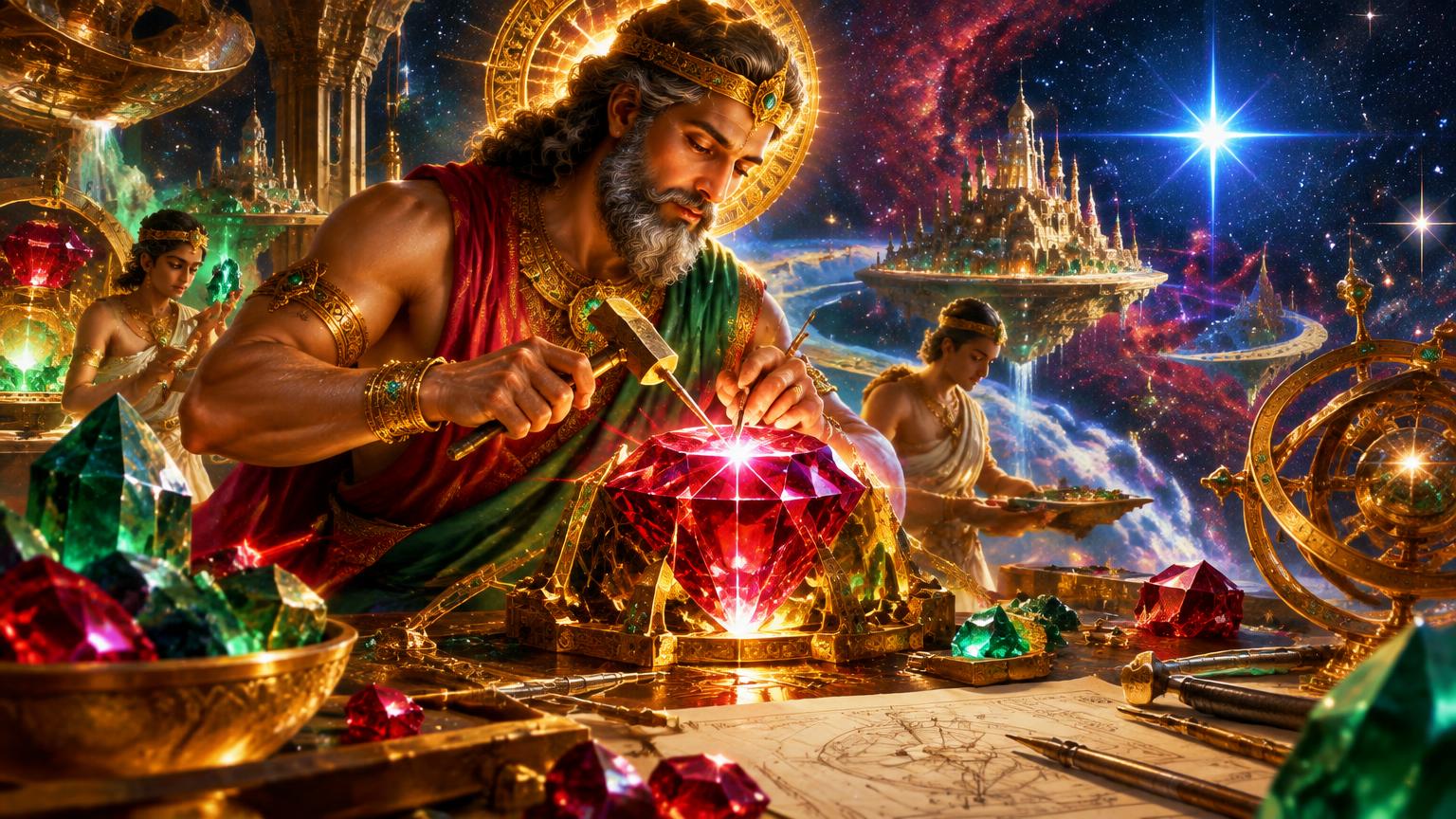
Čitra – beauty that needs genuine substance
Čitra is the fourteenth of the 27 nakshatras, or lunar mansions. It spans 23°20′ Virgo to 6°40′ Libra. Its planetary ruler is Mars. The first part lies in Mercury’s Virgo, the second in Venus’s Libra. It therefore brings together precision, creative courage and a sense of harmony.
Its name is associated with brightness, variety and something extraordinary. Čitra seeks to give form to possibility. It notices how a space, object, idea or way of working could become clearer and more beautiful.
Yet its theme is not simply appearance. It is the relationship between outward brilliance and inner quality. A beautiful product must also work. A compelling presentation needs honest substance.
In the language of Jyotish, or Vedic astrology, Čitra is the creator who refines raw material. Its maturity becomes apparent when it can also recognise the moment when enough polishing has been done.
Essential information
- Number in sequence: 14
- Span: 23°20′ Virgo–6°40′ Libra
- Nakshatra ruler: Mars, or Mangala
- Sign rulers: Mercury in Virgo, Venus in Libra
- Deity: Tvaštar, the divine designer, associated with Višvakarma
- Main symbol: a shining jewel
- Shakti: Punya Chayani shakti, the power to accumulate merit
- Life motivation: kama, desire and fulfilment
- Animal symbol: tiger
- Padas by navamsha: Leo, Virgo, Libra, Scorpio
These degrees refer to the sidereal zodiac used in Jyotish. For a placement close to a boundary, the chosen ayanamsha—the offset used to calculate sidereal positions—also matters.
These are symbolic reference points in traditional astrology, not scientifically validated measures of personality or future events.
Tvaštar – the shaper of divine forms
Čitra’s deity is Tvaštar, the Vedic master of design. He is associated with the emergence of forms, skilled craftsmanship and the creative power that gives tangible expression to something unseen. In later interpretations, he is often associated with Višvakarma, the divine architect. Their roles overlap, but they are not exactly the same figure in every text.
In Vedic tradition, Tvaštar is the maker of Indra’s vajra, the celebrated thunderbolt weapon. For Čitra, the creative theme of this myth is especially important. Even great power needs the right tool. An idea alone is not yet a finished product. Courage alone is not yet skill.
The divine craftsman must understand his material. He must know what it can withstand, how it responds and which form serves its purpose. Čitra likewise matures through learning, experimentation and revision. Inspiration is the beginning of the work, not its completion.
The myth also raises the question of responsibility. A master craftsperson can make something astonishing, yet beauty and technical excellence do not guarantee that it will be used well. What matters is whom it serves.
The practical lesson is simple: before improving something, check its purpose. A good solution is not merely one that demonstrates your ability. It is one that genuinely meets a need.
The symbol of the shining jewel
Čitra’s main symbol is a shining jewel. Its light draws the eye, but the finished brilliance conceals a great deal of work. It requires careful selection of material, cutting and polishing, patience and a sense of proportion.
The jewel represents the ability to bring out what matters most. A good editor removes unnecessary words. A designer finds clear proportions. A teacher presents a complex idea in a way that makes it understandable.
The symbol also has a shadow side. A person may begin to measure value solely by other people’s responses. Whatever goes unnoticed seems less important. This is when presentation overtakes substance.
Mature Čitra does not reject beauty. It understands, however, that brilliance is not proof of quality. It checks the supporting structure first and chooses the decoration afterwards. The same applies to self-image: dignity does not require a flawless performance.
Shakti – the power to accumulate merit
Čitra’s traditional power is called Punya Chayani shakti. It is usually interpreted as the power to accumulate merit, or beneficial karmic fruits. The word punya refers to the beneficial value of actions, not merely success or popularity.
This shakti directs creativity towards the question: what does my work contribute? A product can be beautiful and useful. Words can be skilful and truthful. Influence can be powerful and responsible.
Merit here is not a cosmic currency with which to buy happiness. Good deeds do not guarantee wealth, health or a life without difficulties. The symbolism emphasises the importance of intention, the quality of execution and the consequences.
In everyday life, this power is expressed through work done honestly. Through acknowledging a colleague’s contribution. Through correcting a mistake even though nobody noticed it.
The shadow emerges when good work becomes a performance for an audience. Čitra grows when it does something useful even without applause.
Mars from Virgo into Libra – from making to collaborating
As the nakshatra’s ruler, Mars brings initiative, determination and a need for tangible results. In Čitra, it is not only a warrior. It is also the craftsperson who picks up a tool and begins to work.
In Virgo, its strength meets Mercury’s analytical ability. Process, precision, usefulness and correcting errors come to the fore. The question in this part of Čitra is: how can this be made better?
In Libra, Mars enters Venus’s domain of relationships, proportion and exchange. Here, how the creation will be received becomes important. The question is: how does my solution work among people?
This transition connects technical excellence with social sensitivity. Tension arises when personal will refuses to listen to others, or when accommodation prevents a clear decision.
An important distinction: Mars rules Čitra, but this does not mean that natal Mars is actually in Virgo or Libra. Its actual position in the chart adds further nuance to the nakshatra’s expression.
Inner world and character
A prominent Čitra can accentuate a sense of form, discernment and personal expression. A person quickly notices inconsistencies. Sometimes they see the correction before others even notice the problem.
They are often motivated by the opportunity to make something in their own way. They do not want merely to follow instructions. They like to understand the design and add their personal touch.
A mature expression may include:
- creative independence,
- practical resourcefulness,
- attention to detail,
- the courage to present one’s work,
- persistence in learning a skill,
- respect for quality workmanship.
Behind a confident manner, there may be sensitivity to judgement. It is therefore important to separate what you create from your own worth. Criticism of a solution is not necessarily a rejection of the person who created it.
Čitra’s gifts
Giving ideas a clear form
Čitra can turn a vague idea into a plan, an image or a useful object. It is especially valuable where a good idea gets stuck at the execution stage. It helps identify the first tangible step.
A sense of quality
It notices the difference between a superficial effect and good craftsmanship. This gift is not limited to art. It also appears in documentation, the organisation of work and service design.
Practical resourcefulness
Mars encourages experimentation. When the first solution fails, Čitra can find another tool or a different approach. A limitation becomes a creative question, not necessarily the end of the road.
Compelling presentation
It knows how to highlight what matters. It can present complex material clearly and attractively. A mature expression of this gift supports understanding rather than concealing shortcomings.
Dedication to mastery
It is willing to practise, revise and refine its technique. It understands the satisfaction of a job well done. Mastery grows when comparison with others gives way to tracking one’s own progress.
Bringing beauty and usefulness together
Its particular strength is a solution that works well and is pleasant to use. Beauty is then not an extra. It supports clarity and a good experience.
Shadow sides and inner challenges
Čitra’s precision can turn into perfectionism. Creative independence can become stubbornness. A sense of presentation can become excessive concern with managing impressions.
Common challenges include:
- continually revising something that is already good enough,
- comparing appearances, achievements or recognition,
- difficulty accepting feedback,
- irritation with different ways of working,
- hiding insecurity behind a flawless presentation,
- making promises that exceed what can realistically be delivered.
The distinction between a standard and a defensive wall is especially important. A high standard improves the work. A defensive wall prevents the work from ever being shown.
The key question is: Am I improving the result now, or merely postponing the possibility of being judged?
A finishing point agreed in advance can help. Define the purpose, three quality criteria and a deadline. Once these are met, hand over the work. Further improvements can have their place in a new version.
Four padas – four ways of creating
Each pada, or quarter, spans 3°20′. The navamsha divisional chart reveals an additional layer of expression; it does not replace the sign and house. Which graha, or planetary factor, occupies a particular pada also matters.
1st pada: 23°20′–26°40′ Virgo · Leo navamsha
The first pada connects Virgo’s craftsmanship with Leo’s creative confidence. The Sun rules this navamsha. Authorship, recognition and the desire to create something with a distinctive personal signature may come to the fore. A person wants quality, but also an opportunity to show it.
The gift is the courage to present a well-developed idea. The challenge arises when feedback touches pride more than the work itself. A helpful question is: what in this comment can improve the work? Mature leadership acknowledges collaborators and does not need complete control over every detail. Visibility becomes a responsibility rather than a constant need to prove one’s uniqueness.
2nd pada: 26°40′–30°00′ Virgo · Virgo navamsha
The second pada emphasises Mercury’s analysis, precision and organisation. Because it is in Virgo both in the main chart and in the navamsha, it is vargottama. This means the sign is repeated, not that success is automatically guaranteed. Čitra’s creativity here often seeks a clear process and a verifiable result.
The gift is the ability to improve a system down to its practical details. A person may be skilled at identifying an error, inconsistency or waste of time. The challenge is endless revision. It is useful to distinguish a necessary correction from a personal desire for flawlessness. Maturity also allows learning through an imperfect first attempt.
3rd pada: 0°00′–3°20′ Libra · Libra navamsha
The third pada strengthens Venus’s themes of harmony, cooperation and taste. This pada is also vargottama. Form must now work in relation to a user, audience or collaborator. Creating becomes a conversation between personal inspiration and the needs of others.
The gift is bringing different perspectives together into a harmonious solution. The challenge is dependence on approval or avoidance of necessary disagreement. Clear agreement on criteria and responsibilities helps. Mature harmony does not mean everyone is satisfied all the time. It means they are heard and know how the decision will be made.
4th pada: 3°20′–6°40′ Libra · Scorpio navamsha
The fourth pada combines Libra’s outward harmony with Scorpio’s intensity. Mars rules this navamsha. Interest may shift from appearances to hidden structures, motives and what needs to be thoroughly reworked. Beauty gains greater depth and contrast.
The gift is perseverance through a demanding creative or research process. The challenges are mistrust, hidden competition and a need to control responses. Expressing concerns directly helps. A mature expression of this pada understands that depth does not require secrecy and that strong collaboration also allows vulnerability.
The Moon in Čitra
A natal Moon in Čitra may connect emotional security with a sense of order, capability and personal expression. Creating or improving something can help a person feel their presence in the world more fully.
They need an environment in which they can express their taste and ideas. Yet disorder, unfinished work or harsh criticism may stir more inner unrest than is visible on the outside.
Sometimes they first channel their emotions into action. They tidy a space, repair an object or prepare a solution. This can be useful, but it does not replace talking about feelings.
Simply naming the feeling can help: disappointment, shame, pride, joy or a need for validation. A feeling does not need to be made more attractive before it can be acceptable.
The interpretation of the Moon also depends on its sign, house, aspects and the position of Mars. The Moon’s nakshatra is not the whole personality.
Relationships and intimacy
Čitra can bring attentiveness, creativity and a desire to build something beautiful together into relationships. It expresses affection through an imaginative suggestion, a carefully chosen gift or a practical contribution.
Difficulty arises when a partner becomes an improvement project. Good intentions do not mean that advice is welcome. Nor does a relationship’s polished exterior reveal how much honesty exists between two people.
Its growth in relationships involves three tasks:
- Ask before trying to fix things. Does the other person want a solution, a listening ear or simply closeness?
- Express a need without putting on a performance. A desire for validation is easier to understand when it is stated directly.
- Allow imperfection and difference. A different taste or pace is not evidence of a lack of love.
A useful agreement is to keep comments focused on specific behaviour rather than a person’s worth. Instead of “you never make an effort,” a clear request helps.
Attraction, compatibility or the longevity of a relationship cannot be determined from Čitra alone. Both people, their choices and the wider context matter.
Work, career and money
Čitra’s symbolism connects well with work in which an idea needs thoughtful execution. Fields such as design, architecture, crafts, engineering, programming, photography, text editing or product development may be appealing.
The same energy can be expressed in a completely different profession. One person improves a teaching method. Another organises a workflow. A third creates a clear report that makes decisions easier for others.
The key is not the job title, but the approach to quality. An environment with clear criteria, room for creativity and agreed responsibilities is helpful.
With money, tension may arise between quality and the impression one wishes to make. Good materials can be a worthwhile expense. Buying something to demonstrate status, however, does not resolve inner insecurity.
A budget, an accurate account of time spent and a limited number of revisions offer practical support. Creative work needs clear payment terms.
One nakshatra alone does not determine a career, health, a relationship or the future. Even an astrological assessment of the whole chart does not replace experience, professional advice and personal judgement.
When Čitra works through other grahas
Each graha uses Čitra’s theme of shaping and creating differently. The following descriptions are symbolic starting points, not standalone predictions.
- The Sun may seek identity through authorship, creativity and quality. The task is to separate dignity from admiration.
- Mercury emphasises planning, drawing, writing and technical thinking. It needs clarity without overcomplication.
- Venus strengthens taste, attraction and sensitivity to relationships. Let beauty support authenticity rather than conceal differences.
- Mars emphasises execution, competitiveness and mastery of tools. Patience, agreements and a considered pace are helpful.
- Jupiter may connect creation with teaching, ethics and a broader purpose. A grand vision needs achievable steps.
- Saturn emphasises the discipline of craftsmanship, standards and work developed over a long period. The challenge is rigidity in standards.
- Rahu may intensify innovation and the desire for recognition. Checking promises and motives is important.
- Ketu may encourage exploring the essence of things and stepping away from ornament. The challenge is undervaluing practical presentation.
The meaning changes according to the sign, house, the graha’s dignity, aspects and other connections.
Natal placement, transit and dasha are not the same
A natal placement means that a particular graha or the ascendant was in Čitra at birth. In astrological interpretation, it describes a more enduring symbolic theme. The Moon relates primarily to inner experience, Mercury to thinking, and Venus to values and connection.
A transit is a graha’s current passage through Čitra. The Moon’s passage is brief. You can use it as a reminder to do creative work, review a plan or complete something you are making. It is not a guarantee that the day is favourable for every decision.
A dasha is a longer planetary period. In the Vimshottari system, a natal Moon in Čitra means that life begins in the remaining portion of Mars’s dasha. Its length depends on the Moon’s position within the nakshatra.
Mars’s dasha is not the same as a transit through Čitra. Its interpretation rests on Mars’s actual position and connections. Likewise, not everyone in a Mars dasha has the Moon in Čitra.
The spiritual and karmic lesson
Čitra’s central lesson is to create beauty without tying your own worth to its impact.
In this context, karma can be understood as patterns of actions, responses and consequences. There is no need to infer punishment or supposed guilt from previous lives.
Čitra’s pattern changes when the need to prove oneself gives way to dedication to the work. The question “how will I come across?” then makes room for “what is genuinely needed here?”
Spiritual practice is therefore not necessarily separate from craftsmanship. It can be an honest relationship with the material, the client, a collaborator or your own limits.
Unfinished things also have something to teach. Not everything can be arranged according to your vision. A mature creator works with care, yet accepts that life is not a product under their complete control.
Practical ways to find balance
Define what finished means
Before starting, write down the purpose of what you are making and three essential qualities. Add a deadline. This makes it easier to distinguish an improvement that genuinely helps from revisions driven by fear of judgement.
Create without an audience, too
Once a week, draw, build, write or repair something without sharing it publicly. Notice what brings you joy when other people’s responses are not the goal. It does not have to become something useful.
Separate drafting from evaluation
Create a rough version first. Only then review it. If you judge every idea before it has taken shape, the inner critic takes over the creator’s work.
Ask before offering advice
Before commenting, check whether help is welcome. This applies at work and in personal relationships. The question “would you like a suggestion, or would you just like me to listen?” often prevents unnecessary tension.
Check the purpose of a purchase
Pause before buying an expensive item. Ask yourself whether you are buying usefulness, durability, joy or mainly an impression. No answer calls for shame, but each calls for honesty.
Do something useful without putting your name on it
Share your knowledge, repair a shared object or make someone else’s work easier. Make sure the help is agreed and stays within your limits. In this way, you connect the symbolism of merit with action rather than public recognition.
These practices are possibilities to explore, not compulsory astrological remedies.
Questions for self-reflection
- Where am I caring for genuine quality, and where am I mainly managing an impression?
- Which project could I finish if I allowed the result to be good enough?
- How do I respond when someone does not admire my work?
- In a relationship, am I listening to the person or trying to improve them?
- What would I create even if I received no recognition for it?
Frequently asked questions
Does Čitra indicate beautiful looks?
No. The symbol of the shining jewel is not a reliable prediction of physical characteristics. It speaks more usefully about one’s relationship with form, presentation and quality. Appearance is not a measure of a person’s mature expression of the nakshatra.
Is everyone with a prominent Čitra an artist?
No. Creativity can appear in crafts, organisation, technical work or everyday problem-solving. A nakshatra does not determine a profession and does not replace knowledge, interest or access to education.
What is the difference between the Virgo and Libra portions?
The Virgo portion symbolically emphasises process, detail and usefulness. The Libra portion places greater emphasis on cooperation, harmony and other people’s responses. These are not separate personality boxes. The pada, graha and whole chart matter.
Does Punya Chayani shakti guarantee happiness?
No. It refers to the traditional connection between conscious action and merit. It is not a promise of reward. Nor are difficulties evidence that a person has acted badly or lacks sufficient merit.
How can I check whether my Moon is in Čitra?
You need your birth date, the most accurate birth time possible, your birthplace and a sidereal calculation. Check the Moon’s degree and the ayanamsha used. For a placement close to a boundary, an uncertain birth time may change the classification.
In closing
Čitra speaks of the moment when an idea takes form. It brings together the courage to begin, the patience to make and a sense of beauty.
Its greatest strength is not a flawless surface. It is the ability to create something in which appearance, purpose and quality support one another.
Maturity arrives when a person no longer needs to keep proving their uniqueness. It then becomes easier to accept feedback, acknowledge collaboration and finish work on time.
The shining jewel remains its symbol. Yet its brilliance is not a call to outshine everything else. It is an invitation to make something genuine clearly visible.
Which nakshatra is yours?
Enter your date, time and place of birth — the calculation is free.
Calculate your nakshatra