
Home/Nakshatras/Purva Phalguni
Nakshatra 11 · ruler Venus
Purva Phalguni
Purva Phalguni
Purva Phalguni carries the warmth, creativity, and charm of Venus, together with the good fortune of Bhaga; its imagery also speaks of rest and enjoying the fruits of life. It supports art, music, relationships, sociability, and the gift of inspiring or reassuring others through a kind approach. It finds balance when it connects pleasure with loyalty, generosity, and conscious creation.
- Range
- 13°20′ Leo – 26°40′ Leo
- Ruler (dasha period)
- Venus
- Deity
- Bhaga
- Symbol
- Front legs of a bed
- Gana (temperament)
- Manushya (human)
- Keywords
- —
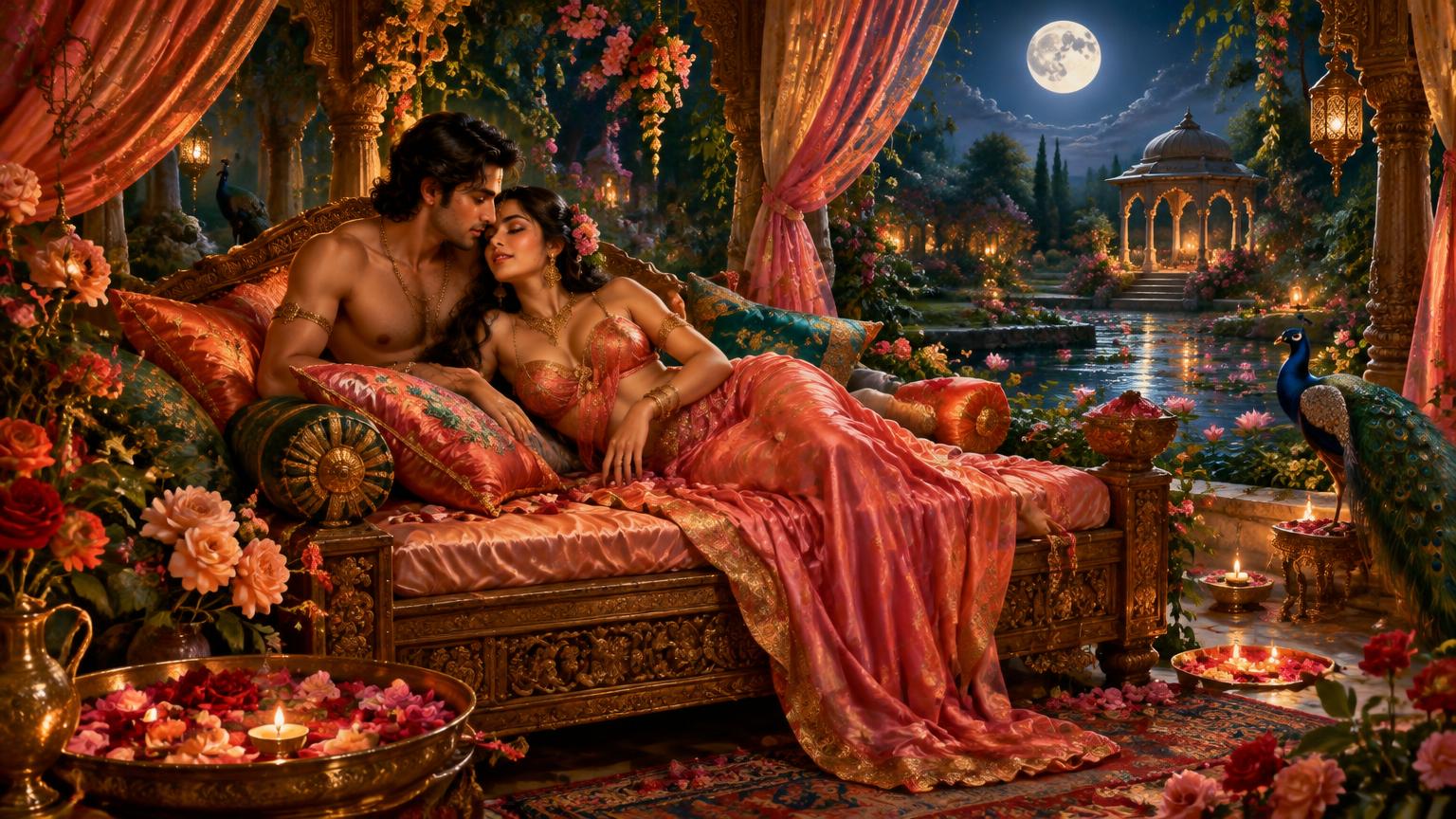
Purva Phalguni – joy that needs conscious form
Purva Phalguni is the eleventh of the 27 nakshatras, or lunar mansions. It spans 13°20′ to 26°40′ Leo. Its planetary ruler is Venus, while Leo is ruled by the Sun. This combination brings together pleasure, creativity, dignity and the desire for personal expression.
Venus seeks connection and enjoyment of beauty. The Sun seeks to shine and live from its own centre. Purva Phalguni therefore raises the question of how to be seen, loved and fulfilled without becoming dependent on admiration.
This is a nakshatra of rest, companionship and life's generative potential. It is not only about entertainment. It is about the space in which we can relax and create something new.
Here, we explore its symbolism within Jyotish, the Vedic astrological tradition. This is a traditional language of interpretation, not a scientifically validated method of prediction.
Essential details
- Sequence number: 11
- Span: 13°20′–26°40′ Leo in the sidereal zodiac
- Nakshatra ruler: Venus, or Shukra
- Sign ruler: The Sun, or Surya
- Deity: Bhaga, the deity of one's share, prosperity and the enjoyment of life's gifts
- Main symbols: A hammock and the front legs of a bed
- Shakti: Prajanana shakti, the power of generation
- Gana: Manushya, the human temperament group
- Life motivation: Kama, desire and fulfilment
- Animal symbol: Rat
- Pada navamshas: Leo, Virgo, Libra and Scorpio
The name can be understood as “the earlier Phalguni”. Together with the next nakshatra, Uttara Phalguni, it forms a symbolic pair. Purva emphasises attraction, meeting and enjoyment. Uttara places greater emphasis on agreement, support and lasting commitment.
Bhaga – a fair share of life's gifts
The deity of Purva Phalguni is Bhaga, one of the Adityas. In the Vedic tradition, he is associated with one's share, good fortune, prosperity and the opportunity to enjoy what is good. He does not represent possession alone. How we distribute resources and whom we share them with also matter.
His image evokes a host setting a table. The food matters, but true abundance emerges only when people can sit down together. The gift of this nakshatra is therefore not simply acquiring pleasant experiences. It is creating conditions in which others feel good too.
In some versions of the later myth of Daksha's sacrifice, Bhaga loses his eyes during the destruction of the ritual. The stories differ in their details. Symbolically, this motif can raise the question of blindness to the consequences of pleasure, privilege or social standing.
It is not helpful to read this as a prediction of loss or punishment. The useful lesson is simpler: good fortune needs discernment. Not everything pleasant is also fair. Mature Purva Phalguni knows how to accept its share without overlooking others.
The hammock and the front legs of a bed
The hammock represents relaxation, trust and a temporary retreat from effort. It is impossible to lie comfortably in one while constantly clinging to control. The image therefore also speaks of the ability to receive.
The front legs of a bed emphasise the beginning of rest, closeness and shared space. A bed can be a place of intimacy, but also of rest, conversation and new ideas. The symbol need not be limited to sexuality.
Both symbols need support. A hammock needs two secure anchor points. A bed needs stable legs. Freely enjoying life also needs a framework: time, resources, consent and responsibility.
In everyday life, this means allowing ourselves a break without shifting the entire burden onto someone else.
Shakti – the power of generation
The power of Purva Phalguni is called Prajanana shakti. Traditionally, it means the power of generation or producing offspring. In a broader symbolic interpretation, it can also be understood as the capacity for something new to emerge through connection.
This might be a work of art, a shared project, a celebration or an idea that comes alive among people. Individual effort is not the only key. Meeting, responsiveness and conditions that give creativity room to grow also matter.
This shakti does not promise fertility, nor does it suggest that everyone must become a parent. We cannot infer reproductive health or life choices from a nakshatra.
Its practical lesson is clear. Inspiration needs follow-through. If we always stop at the pleasant beginning, the potential remains unrealised. Mature creative power also nurtures something, develops it and brings it into the world.
Venus in Leo – pleasure and dignity
As the nakshatra's ruler, Venus brings a capacity for connection, taste, attraction and a sense of value. Leo, under the Sun's rulership, adds warmth, pride, creative confidence and a need for authentic expression.
The phrase Venus in Leo here describes the interplay between the nakshatra's ruler and its sign. It does not mean that everyone with a prominent Purva Phalguni also has natal Venus in Leo.
Venus asks: What connects us? The Sun asks: Who am I? A mature answer does not require choosing between closeness and independence. We can honour our own worth while also respecting another person's.
Tension arises when the desire for love becomes a demand for admiration. Kindness then becomes a performance. Balance returns when a person creates out of genuine joy, not only for an audience's response.
Inner life and character
When Purva Phalguni is prominent, there may be a sensitivity to atmosphere. How a space feels, how people speak and whether a relationship has enough warmth become important.
Such a person may quickly sense what would make a gathering more enjoyable. They add music, humour, a good question or a beautiful detail. In its mature expression, this is not a way of buying affection. It is simply a sharing of joy.
Common possibilities for expression include:
- social warmth and hospitality,
- a strong sense of beauty,
- creative playfulness,
- a desire for independent expression,
- appreciation of comfort and leisure,
- sensitivity to rejection,
- generosity towards loved ones.
Sociability is not a required trait. A more reserved person can also express this symbolism through a well-kept home, private creative work or a carefully chosen circle of people.
The gifts of Purva Phalguni
Creating a welcoming space
One gift is the ability to help people relax and work together more easily. A good host does not need luxury. They need attentiveness to people, their comfort and their differing needs.
Artistic sensitivity
Colour, sound, rhythm or words can become a natural means of expression. The mature gift is not merely good taste. It is the willingness to develop a skill even after the initial inspiration has passed.
Warm connection
Purva Phalguni can ease unnecessary social tension. Humour and kindness open doors. They are most helpful when they do not conceal real differences or uncomfortable questions.
The ability to receive
Some people find it difficult to accept help, praise or rest. This nakshatra reminds us that life is not only duty. Receiving what is good can be a mature skill, not a sign of weakness.
Generous celebration
It knows how to notice an achievement and acknowledge it. Celebration strengthens bonds and gives work human meaning. Its value lies not in the cost of the occasion, but in sincere attention.
Shadow sides and inner challenges
The shadow appears when pleasantness becomes the main criterion for making decisions. A person may neglect something important simply because it requires effort or an uncomfortable conversation.
Common challenges include:
- putting off tedious responsibilities,
- spending to make an impression or in response to a passing mood,
- excessive sensitivity to a lack of praise,
- accommodating others to remain popular,
- confusing attraction with reliability,
- expecting special treatment,
- escaping into entertainment instead of making a clear decision.
These are not inevitable traits of people with this nakshatra. They are possibilities worth examining without judgement.
The key question is: Does this pleasure truly replenish me, or does it merely postpone something I find difficult to face?
Mature Purva Phalguni does not reject joy. It learns to distinguish between rest that renews our readiness for life and avoidance that limits our freedom.
Four padas – four ways of expressing the same theme
Each pada, or quarter, spans 3°20′. The degrees below refer to sidereal Leo. The navamsha, a division used in Jyotish, adds a mode of expression, but does not replace the significance of the graha, or planetary factor, the house or the chart as a whole.
1st pada: 13°20′–16°40′ Leo · Leo navamsha
The first pada is ruled by the Sun. Because both the sign and navamsha are Leo, this is a vargottama placement. It emphasises consistency in the sign's symbolism, but does not guarantee success. Creative presence, dignity and the desire to give something personal a visible form take centre stage.
The gift is warm leadership that allows others to shine too. The challenge arises when recognition becomes a condition for cooperation. A useful practice is to share credit and finish work even without an audience. Confidence then depends less on the response of others.
2nd pada: 16°40′–20°00′ Leo · Virgo navamsha
The second pada is ruled by Mercury. It seeks to translate beauty into a useful form. It emphasises skill, refinement, detail and quality of execution. Creativity may find expression through design, writing, event organisation or thoughtful care for the everyday environment.
The gift is a combination of taste and precision. The shadow is the belief that pleasure is permitted only after achieving a perfect result. Balance requires realistic standards. Sometimes work that is good enough is more alive and useful than endless revision.
3rd pada: 20°00′–23°20′ Leo · Libra navamsha
The third pada is ruled by Venus. It places greater emphasis on cooperation, aesthetics, fair exchange and the desire for reciprocity. A person may have a good feel for social dynamics and be able to bring differing wishes into a shared agreement.
The gift is creating harmony that leaves no one out. The challenges are people-pleasing and indecision born of a fear of losing affection. Its mature expression can also voice an unpopular truth. A good relationship does not need constant agreement, but respect and clarity.
4th pada: 23°20′–26°40′ Leo · Scorpio navamsha
The fourth pada is ruled by Mars. It adds intensity, privacy and a need for emotional truth beneath the pleasant surface. Creativity or closeness can become a space for deeply exploring desire, trust and personal boundaries.
The gift is the courage to make honest contact even with less comfortable feelings. The challenge may appear as jealousy, testing loyalty or control. Direct questions and clear agreements help. Strong attraction does not, in itself, mean safety or compatibility.
The Moon in Purva Phalguni
A natal Moon in this nakshatra is traditionally associated with a need for warmth, pleasant surroundings and a sense of acceptance. Creative activity, companionship and time free from pressure may support emotional security.
Such a person may express affection through an invitation, a small thoughtful gesture or a shared experience. Often, it is not enough for a relationship simply to function. They also want a sense of aliveness and joy.
When faced with rejection, there may be a temptation to prove their worth through greater friendliness, appearance or performance. It is more helpful to identify the specific need: am I missing attention, rest, respect or a clear answer?
The Moon's nakshatra does not describe the whole person. Astrological interpretation also considers the Moon's house, its connections, the ascendant and the placements of Venus and the Sun. Actual circumstances and personal choices have their own place, regardless of the chart.
Relationships and closeness
In relationships, Purva Phalguni emphasises attraction, playfulness and shared enjoyment. Closeness grows more easily where responsibilities leave room for laughter, mutually desired touch and relaxed time together.
Yet a pleasant beginning does not replace reliability. A relationship also needs conversations about time, money, privacy and the work each person takes on.
Three important relationship tasks are:
- Distinguish attention from validation of your worth. A partner's tiredness or independent activity is not necessarily rejection.
- Express your wishes and respect boundaries. Attraction does not replace clear, freely given consent. Even in a long-term relationship, the right to give a different answer remains.
- Share responsibility for life together. Enjoyment is freer when everyday care does not fall to one person by default.
A nakshatra alone does not determine the quality or duration of a relationship. Comparing two charts cannot replace observing behaviour either. Respect, consistency and the ability to repair mistakes tell us more than an appealing astrological description.
Work, career and money
This symbolism may find expression in work that combines creativity, contact with people and an awareness of the quality of an experience.
Possible areas of interest include:
- art, music and design,
- hospitality and event organisation,
- cultural projects and the performing arts,
- communication and presenting ideas,
- arranging and styling spaces,
- customer-facing work and service development.
These are not career predictions. One nakshatra alone does not determine a career, health, a relationship or the future. Knowledge, training, opportunities and genuine wishes also matter in work.
The practical challenge is to connect inspiration with execution. A good idea needs a deadline, a budget and an agreement on responsibilities. Even an enjoyable collaboration needs clear pricing.
With money, it helps to distinguish quality from a purchase made for status. A beautiful object can be a worthwhile pleasure. The difficulty arises when we use a purchase to prove that we belong. Setting aside a specific amount for enjoyment allows pleasure without neglecting essential commitments and savings.
When Purva Phalguni works through other grahas
A graha shows which function of life is expressed through the nakshatra's symbolism.
- The Sun emphasises creative identity and dignity. The challenge is an excessive need for recognition.
- Mercury may express playful speech, aesthetic judgement and an ability to connect people. Precision in agreements remains important.
- Venus strengthens themes of attraction, enjoyment and values. Its proximity to the Sun also needs to be considered.
- Mars adds initiative, competitiveness and intensity of desire. Patience and respect for boundaries are helpful.
- Jupiter emphasises generosity, mentoring and the meaning of celebration. Its shadow is excess or overpromising.
- Saturn raises questions of responsibility, earned rest and enduring creative work. It does not automatically mean a loss of joy.
- Rahu may intensify the desire for visibility, distinctiveness or new experiences. It needs clear personal standards.
- Ketu may open an exploration of fulfilment beyond applause. It does not require rejecting relationships or beauty.
These are symbolic starting points. The interpretation changes according to each graha's house, dignity, aspects and other connections.
A natal nakshatra, a transit and a dasha are not the same
A natal placement means that the Moon, ascendant or another graha was in Purva Phalguni at birth. In astrological interpretation, it describes a more enduring theme, not a constant mood.
A transit is a graha's current passage through this region. The Moon travels through it in approximately one day; slower grahas take longer. Such a passage can be used symbolically to reflect on rest, relationships or creativity. It does not guarantee a happy event.
A dasha is a time period within a particular astrological system. In the Vimshottari system, a natal Moon in Purva Phalguni means that life begins during the remaining portion of Venus's mahadasha, or major period. The length of that remainder depends on the Moon's exact position.
A Venus dasha is not the same as a Venus transit or a natal Moon in this nakshatra. Its interpretation includes Venus's full placement and the subperiods. The name of the period alone cannot tell us that the time will necessarily be pleasant, romantic or financially successful.
The spiritual and karmic lesson
The central lesson of Purva Phalguni is to enjoy without losing freedom, and to share without buying love.
In this context, karma is not punishment. It concerns repeated actions and their consequences. If we always avoid an uncomfortable conversation, we may preserve pleasantness in the short term while weakening trust over time.
Spiritual maturity does not require renouncing beauty. It requires an honest relationship with desire. We can want something without allowing it to make every decision for us.
Bhaga's symbolism adds the question of a fair share. Can I receive what is good without guilt? Do I also notice the work of the people who make my comfort possible?
The path of this nakshatra leads from the need for admiration towards self-worth. From consumption towards creation. From momentary enchantment towards a joy that can also sustain everyday responsibility.
Practical ways to find balance
Plan your rest
Set aside time in your calendar with no obligations. Give it a beginning and an end. Rest then becomes a conscious choice rather than unnoticed procrastination. Afterwards, check whether you feel more ready to take the next step.
Create without an audience
Once a week, write, draw, sing or design something without posting it. Achievement is not the aim. Notice what brings you joy even when there is no praise, comparison or external validation.
Budget for pleasure
Decide how much you can devote to beauty, companionship or entertainment. Pause before a larger non-essential purchase. Ask yourself whether you are buying usefulness, enjoyment or a sense of social worth.
Practise making a direct request
Instead of hinting, say: “I would like more time together.” Then listen to the answer. A clear request leaves the other person free to respond. Testing their affection, on the other hand, often creates unnecessary uncertainty.
Finish something small
Choose a creative task of manageable scope. Define what finished means, and complete it. This connects Prajanana shakti with nurturing what has come into being, not only with enthusiasm for the beginning.
Share your portion
Give time, knowledge or resources within your means. You can also pay someone fairly for their creative work. The purpose is not to earn credit, but to contribute consciously to prosperity that extends beyond yourself.
Questions for self-reflection
- Which pleasures truly replenish me, and which merely cover up discomfort?
- How do I behave when my work does not receive the praise I expected?
- Are both enjoyment and responsibilities clearly agreed upon in my relationships?
- What do I want to create, even if no one admires it?
- How can I accept my share of life's gifts while also noticing the needs of others?
Frequently asked questions
Does Purva Phalguni mean laziness?
No. A symbol of rest is not a description of someone's capacity for work. It may highlight the importance of creative rhythm and fulfilment. Procrastination is one possible shadow, not an inevitable trait of a person with this nakshatra.
Does Prajanana shakti predict children?
No. The traditional association with generation does not allow reliable conclusions about parenthood or fertility. Creativity takes many forms. Health questions belong with appropriately qualified professionals, not with conclusions drawn from an astrological symbol.
Does this nakshatra guarantee attractiveness and a happy relationship?
No. Attraction is subjective, and the quality of a relationship develops through both people's behaviour. A nakshatra can offer a language for exploring closeness. It does not guarantee fidelity, compatibility or the length of a life together.
Why are the padas important?
The padas distinguish different ways of expressing the same underlying theme. Leo emphasises visibility, Virgo execution, Libra reciprocity and Scorpio depth. We always read them together with the graha placed in them and the wider context of the chart.
How can I check whether Purva Phalguni is prominent in my chart?
You need reliable birth details and a sidereal calculation with a specified ayanamsha, the offset used to calculate sidereal positions. Check the Moon, ascendant and other grahas between 13°20′ and 26°40′ Leo. Near the boundaries, differences in time or calculation may change the classification, so be careful about drawing quick conclusions.
In closing
Purva Phalguni reminds us that joy is not an insignificant addition to life. It can be a source of creativity, connection and willingness to work. Yet its depth grows alongside responsibility.
A hammock needs support. Closeness needs consent. A creative spark needs time and care. Prosperity becomes richer when we recognise other people within it too.
Mature Purva Phalguni does not demand that every moment be pleasant. It knows how to remain present when something needs to be put in order, a mistake acknowledged or a boundary set.
Its wisdom is simple: allow yourself what is good, but do not confuse it with your worth. Enjoy beauty, and create from it something that can live beyond the enthusiasm of the moment.
Which nakshatra is yours?
Enter your date, time and place of birth — the calculation is free.
Calculate your nakshatra