Home/Nakshatras/Magha
Nakshatra 10 · ruler Ketu
Magha
Magha
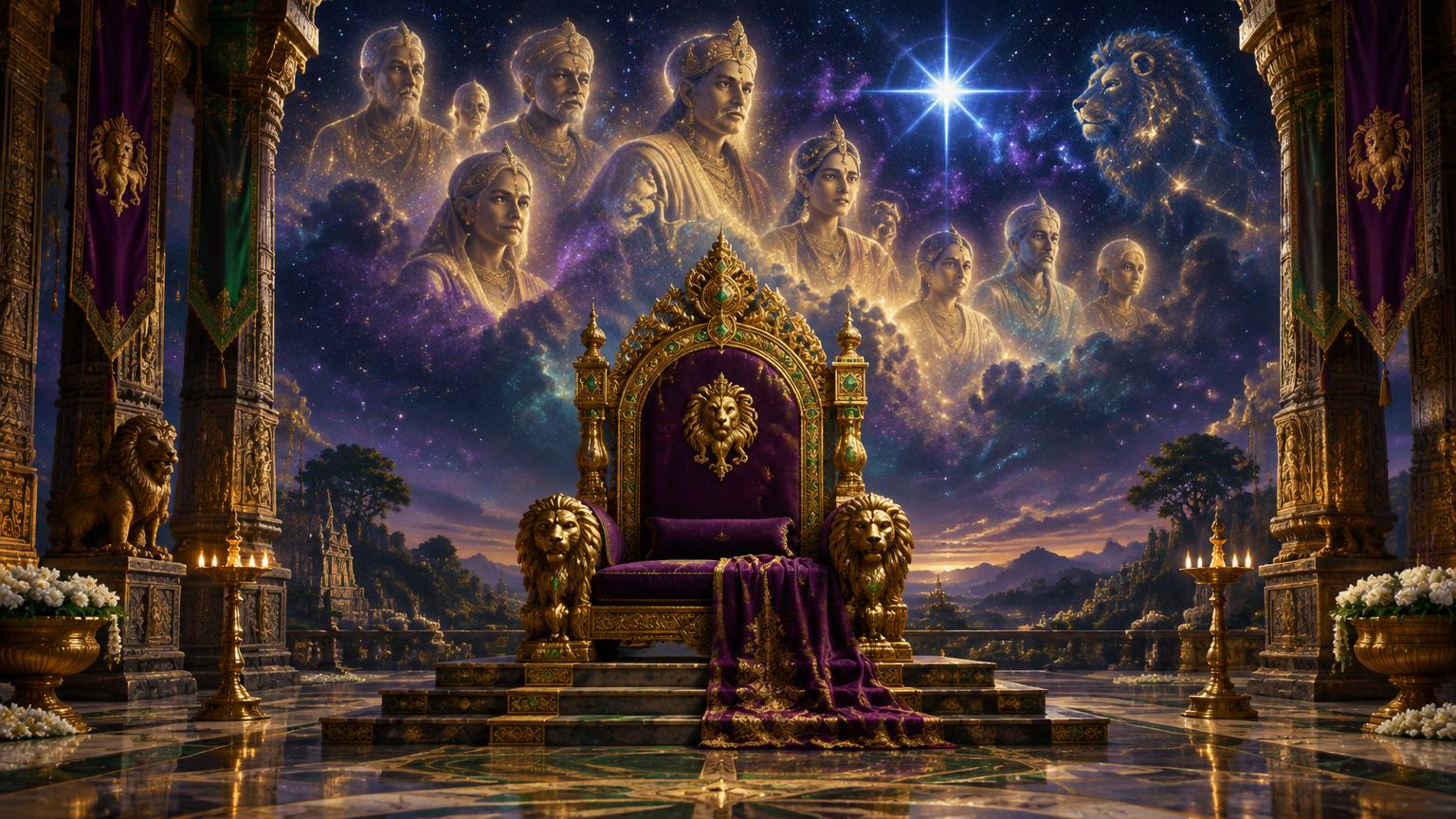
Magha, meaning “mighty”, is associated with ancestors, royalty, heritage, and natural authority. It brings dignity, loyalty to tradition, the ability to complete important work, and a desire to create something that will outlive the individual. Its growth begins when pride becomes noble leadership and privilege becomes responsibility towards family, community, and roots.
- Range
- 0°00′ Leo – 13°20′ Leo
- Ruler (dasha period)
- Ketu
- Deity
- Ancestors
- Symbol
- Royal throne
- Gana (temperament)
- Rakshasa (fierce)
- Keywords
- —
1. Maga – dignity that knows its roots
Maga is the tenth of the 27 nakshatras (lunar mansions). It spans 0°00′ to 13°20′ Leo in the sidereal zodiac. Its planetary ruler is Ketu, while the sign of Leo is ruled by the Sun. This connection raises questions of identity, belonging, and our relationship with power.
The Sun wants to shine. Ketu reminds us that no role is permanent. Maga therefore speaks not only of status, but also of the responsibility we accept alongside it.
Its name is associated with greatness, might, and gifts. Yet its wealth is not necessarily material. It may be knowledge, family memory, integrity, or the ability to uphold values in difficult times.
In the symbolic language of Jyotish (Vedic astrology), Maga asks: What have I received, and what will I pass on? Astrological interpretation is best used for self-reflection. It is not a scientifically validated method for determining character or predicting life events.
2. Essential information
- Number: 10
- Span: 0°00′–13°20′ Leo
- Nakshatra ruler: Ketu, the south lunar node
- Sign ruler: the Sun, or Surya
- Deities: Pitri, the ancestors
- Main symbol: a royal throne
- Related symbol: a palanquin, or carried litter
- Shakti: Tyaga Kshepana shakti
- Life motivation: artha, resources and material support for life
- Traditional nature: ugra, fierce or forceful
- Gana: rakshasa
- Animal symbol: rat
- Navamshas of the four padas: Aries, Taurus, Gemini, Cancer
The term rakshasa is not a moral label. It does not mean a bad person. It is a traditional symbolic classification and should not be used to judge anyone’s worth.
The designation ugra does not necessarily describe behaviour either. In traditional electional astrology—the selection of auspicious times—it identifies the nature of activities involving decisive interventions and breaks.
3. Pitri – ancestors and inherited responsibility
The deities of Maga are the Pitri. In Vedic tradition, they represent the ancestors and the connection between the living and past generations. Their symbolism encompasses origins, memory, the continuation of life, and responsibility for what has been received.
Ancestors are more than names on a family tree. They leave behind language, customs, knowledge, and ways of surviving. They may also leave prohibitions, unspoken stories, or standards of success that no one questions any longer.
Maga therefore invites discernment. Some things from the past support us. Some need to be revised. Others can be respectfully set aside.
Respecting our ancestors does not require us to excuse their actions. We can acknowledge the gifts we have received while rejecting violence, humiliation, or control. Keeping a safe distance from family does not necessarily mean rejecting our roots.
Exploring our ancestry can be entirely practical. Recording stories. Organising photographs. Researching migrations. Talking about family values. When information is missing, there is no need to invent explanations.
Maga also makes room for chosen ancestors: the teachers, mentors, and communities whose work we carry forward. Belonging is not limited to biological kinship.
4. The royal throne and the palanquin
The royal throne represents position, legitimacy, and responsibility. Whoever sits upon it has greater influence. Their decisions therefore reach more people.
In its mature expression, Maga understands that a position is not personal property. It is a temporary trust. A leader safeguards the process, listens to different perspectives, and accepts the consequences of their decisions.
The throne also has a shadow. A person may begin to expect special treatment. Criticism feels like an insult. They forget that a title guarantees neither knowledge nor integrity.
The palanquin, or carried litter, highlights another side of the same story. One person is carried by others. Their comfortable position is made possible by the work of people who often remain unseen.
This symbol poses a simple question: who supports my success? The answer may include family, colleagues, public institutions, and earlier generations.
Maga’s dignity grows when it can acknowledge the contributions of others. The throne then ceases to be a stage for proving oneself. It becomes a place of responsible service.
5. Tyaga Kshepana shakti – the power of departure and letting go
Maga’s traditional power is called Tyaga Kshepana shakti. It is usually translated as the power to leave the body, or the power of departure and relinquishment. It is associated with the transition from one form of existence to another.
We do not use this symbol to predict death. It does not tell us when or how life will end. When reflecting on character, we can read it as a reminder that roles and positions are impermanent.
A title is not the whole person. Family history is not the entirety of their future. Even an achievement that once brought meaning can become too confining.
Maga thus connects preservation with farewell. It protects what has value while learning to release a form that no longer serves that value.
In everyday life, this may mean handing over leadership, ending an obligation that has lost its purpose, or letting go of the need to have the last word. Mature relinquishment is not self-abasement. It is the ability to recognise when something is no longer ours to carry.
6. Ketu in Leo and the Sun
Here, the expression Ketu in Leo primarily refers to the meeting of the nakshatra’s ruler with the sign in which Maga lies. It does not mean that everyone with the Moon in Maga also has natal Ketu in Leo.
In Jyotish, Ketu is associated with separation, non-attachment, and experience that has become familiar. The Sun represents conscious identity, visibility, a central sense of direction, and authority.
Their meeting creates tension. One part of a person may want recognition. Another wonders why they need it at all. Pride in an achievement may coexist with a sudden sense of emptiness afterwards.
The mature expression is not the erasure of personality. It is a clear identity without the constant need to prove oneself. A person can lead without needing to be the most important person in the room.
If Ketu itself is also in Maga, this further emphasises the symbolism of ancestry and identity. Interpretation, however, requires examining its house, its connections, and the Sun’s position. The placement alone does not determine the outcome.
7. Inner life and character
A strong Maga emphasis may highlight a need for dignity, belonging, and respectful treatment. It matters how people honour their promises. A person notices how others treat elders, mentors, and shared work.
Outwardly, they may appear confident. Inwardly, they may be sensitive to exclusion or loss of standing. Sometimes it is easier for them to take responsibility than to admit they need support.
They may be drawn to history, rituals, and objects that carry memories. Yet they are not necessarily traditionalists. They may want to thoroughly reform the very structures they have inherited.
There is an important distinction between inner integrity and rigidity. Integrity allows us to acknowledge a mistake. Rigidity defends an image of infallibility. Maga matures when self-respect no longer depends on presenting a flawless image.
8. Maga’s gifts
Dignified leadership
Maga may support the ability to step forward when a group needs direction. A mature leader does not take up all the space. They create a framework in which others can contribute too.
Protecting what is precious
Maga recognises knowledge, customs, and achievements worth preserving. It does not maintain a tradition simply because it is old. It asks what still supports life.
Loyalty and responsibility
Once Maga accepts something as its task, it can persevere. This gift is especially useful in long-term projects, where the initial enthusiasm soon fades.
A sense of continuity
Maga understands that a good result rarely emerges from nothing. It can connect past work with future needs, helping knowledge and responsibility pass to the next generation.
Generosity
In its balanced expression, Maga readily shares opportunities, resources, and recognition. Its strength is not diminished when someone else shines.
The ability to hand over
A particular gift is knowing when to leave a position. A person can prepare a successor and give them room to lead. This shows that the purpose matters more than being personally indispensable.
9. Shadows and inner challenges
Maga’s shadow often begins where it confuses respect with submission. A person no longer wants cooperation. They want confirmation of their position.
Possible expressions include:
- excessive sensitivity to criticism,
- comparing family backgrounds or reputations,
- expecting privileges without contributing,
- maintaining customs that harm others,
- shame about family history,
- hiding insecurity behind formality,
- withdrawing abruptly when recognition is not forthcoming.
The other extreme is a complete rejection of one’s roots. A person wants to be free, yet still shapes every choice in opposition to the past.
The key question is: Am I acting on my values, or defending an image I feel compelled to maintain?
Balance does not require abandoning ambition. It requires linking influence with responsibility. Clear agreements, verifiable results, and people who can speak uncomfortable truths without fear of punishment can all help.
10. The four padas – Aries, Taurus, Gemini, and Cancer
Each pada, or quarter, spans 3°20′. Its navamsha—a ninth-division placement—adds another quality to the nakshatra’s expression. The ranges below are positions in Leo, not in the navamsha signs. Each boundary belongs to the following pada.
1st pada: 0°00′–3°20′ Leo · Aries navamsha
The first pada is ruled by Mars at the navamsha level. It emphasises initiative, courage, and directness. Here, Maga wants to take on a task and demonstrate its ability. Ancestral heritage may be understood as a call to independent action, not simply to preserve what has been received.
The gift is a decisive beginning. The challenges are haste and a need to prove one’s right to lead. Maturity means distinguishing courage from competition for dominance. It helps to clarify the goal first, then apply one’s strength.
2nd pada: 3°20′–6°40′ Leo · Taurus navamsha
The second pada is ruled by Venus. It emphasises stability, an appreciation of quality, material support, and the preservation of value. Heritage may take the form of a home, land, art, or well-organised work. Something that endures over time becomes important.
The gift is the ability to create a lasting foundation. The challenge arises when comfort or possessions become proof of personal worth. The mature expression can enjoy life without showing off. It can also let go of an expensive habit that no longer has a meaningful purpose.
3rd pada: 6°40′–10°00′ Leo · Gemini navamsha
The third pada is ruled by Mercury. It emphasises speech, learning, making connections, and passing on stories. Here, Maga explores the origins of ideas and interprets the past in contemporary language. It may express itself through writing, teaching, archiving, or negotiation.
The gift is the ability to make a complex heritage understandable. The challenges are speaking to impress and collecting information without checking it. The mature expression clearly distinguishes documented fact, family narrative, and personal interpretation. It builds authority through the quality of its content.
4th pada: 10°00′–13°20′ Leo · Cancer navamsha
The fourth pada is ruled by the Moon. It emphasises belonging, emotional memory, and protecting one’s close circle. Family stories may have strong personal significance. Leadership expresses itself through care, hospitality, and creating a space where people feel accepted.
The gift is compassionate stewardship of a community. The challenge is equating closeness with a duty to stay at any cost. Maturity brings boundaries that do not erase warmth. A person can love their roots while choosing a different life.
11. The Moon in Maga
The Moon in Maga symbolically connects emotional security with belonging and recognition. What matters is the feeling of having a place of one’s own—not necessarily the highest place, but a respected one.
Family events, anniversaries, and keepsakes may carry considerable emotional weight. A person may wonder whether they are carrying forward something worthwhile. At times, they may feel pressure to live up to the expectations of earlier generations.
When hurt, they may become formal or retreat into proud silence. Instead of asking for closeness, they display self-sufficiency. It helps to name the actual feeling: sadness, fear of rejection, or a need for support.
The Moon in Maga does not necessarily mean close family relationships. It may also emphasise a search for belonging outside one’s original environment.
Interpretation takes into account the Moon’s house, aspects, and phase, the positions of Ketu and the Sun, and the chart as a whole. One nakshatra cannot describe an entire emotional life.
12. Relationships and three relationship tasks
In relationships, Maga may seek loyalty, respect, and a clear sense of mattering to one another. Empty attention is not enough. What matters is whether the other person keeps their word and behaves with dignity even during disagreement.
Problems arise when a relationship becomes a hierarchy. One person decides; the other affirms. Or family expectations carry more weight than the agreement between the partners.
Maga’s three relationship tasks are:
- Express a need without testing loyalty. Rather than expecting the other person to guess, say clearly what is needed.
- Separate partnership from family duty. Customs can be an invitation. They must not become a compulsory measure of love.
- Allow disagreement between equals. A different opinion is not automatically disrespectful. Closeness needs room for correction.
It is also important to share credit for the life built together. Invisible work matters as much as a visible achievement.
Compatibility cannot be determined from one nakshatra. An astrological comparison is no substitute for observing behaviour, safety, communication, and shared values.
13. Work, career, and money
Maga is symbolically associated with leadership, institutions, succession, and safeguarding standards. Its themes may be useful wherever an organisation’s history needs to be connected with a new direction.
Possible fields include:
- management and coordination,
- archival studies, history, and museum work,
- law, protocol, and public administration,
- mentoring and the transfer of professional expertise,
- family businesses and succession planning,
- cultural heritage, design, and event organisation.
These are not prescribed careers. An astrological assessment of work requires the broader chart, especially the tenth house and its ruler.
With money, it is important to distinguish security from status. A quality object may have practical value. A purchase made to prove oneself can quickly become a burden.
Inheritance matters benefit from transparent documentation, clear agreements, and professional assistance. An emotional bond does not replace proper legal arrangements.
Maga’s mature approach to finances asks: am I using resources to support life, or to maintain the appearance of status? The nakshatra alone promises neither wealth, inheritance, nor business success.
14. Maga through other grahas
Alongside the Moon, other grahas—planetary factors in Jyotish—also express themselves through Maga. Their themes differ.
- The Sun emphasises questions of legitimate authority. The challenge is to separate personal worth from titles and approval.
- Mercury directs attention towards history, speech, and advising. It calls for checking sources and being willing to revise one’s position.
- Venus connects relationships and beauty with dignity. Care is needed so that quality does not become a competition for prestige.
- Mars emphasises defending the community and decisive leadership. Its challenge is to respond proportionately to opposition.
- Jupiter raises questions of ethics, tradition, and mentorship. Wisdom grows when there is room for new understanding.
- Saturn emphasises duty, hierarchy, and responsibility over time. It calls for distinguishing loyalty from an exhausting obligation.
- Rahu may intensify an interest in influence or social advancement. The integrity of the path taken and respect for boundaries become important.
- Ketu highlights non-attachment and the search for identity beyond status. Withdrawal can be helpful, but it is not automatically a sign of maturity.
These are symbolic starting points. A full interpretation includes the house, the graha’s dignity, aspects, and other connections.
15. Natal placement, transit, and dasha
A natal placement describes a theme that an astrologer considers part of the chart’s broader pattern. The Moon, ascendant, and individual grahas in Maga do not mean the same thing.
A transit is a current passage through its span. The Moon’s passage is brief. We can use it as a symbolic reminder to organise memories, review responsibilities, or thank a mentor. By itself, it does not predict a family event.
A dasha is a time period within a particular astrological system. In the Vimshottari system, Maga is associated with Ketu. If the natal Moon is in Maga, the remaining portion of Ketu’s dasha at birth is calculated from the Moon’s exact position.
This does not mean that Ketu determines an entire life. Nor is its dasha the same as a transit through Maga.
A personal interpretation requires appropriate birth data and a clearly defined calculation method. Differences between ayanamshas—the offsets used to calculate sidereal positions—can change the classification of placements close to a boundary.
16. The spiritual and karmic lesson
Maga’s karmic lesson can be summarised as follows: receive your heritage without becoming its prisoner.
Here, karma is understood as a language of patterns, actions, and consequences. It is not proof of guilt arising from supposed past lives. Nor is a family difficulty a sign that a person carries a curse.
Maga invites a mature use of influence. We can build on what we have received. We can interrupt what is harmful. We can pass on what is good without demanding everlasting gratitude.
Its spirituality is not necessarily ritualistic. It may appear in a fair succession process, in acknowledging colleagues, or in apologising to someone younger.
The deepest shift occurs when the question “How will I remain important?” is replaced by “What will work better after I leave?”
17. Six practices for balance
1. Write down inherited values
Make three columns: keep, adapt, and release. Use them to list family customs and beliefs. Decide according to their effects today, not simply their age.
2. Explore without pressure
Ask a relative about an event or look through documents. Respect the right to privacy. If contact is unsafe, limit your research to available sources or your own memories.
3. Practise helping quietly
Do something useful without receiving public credit. Notice any discomfort. The aim is not to devalue your contribution, but to examine your relationship with recognition.
4. Hand over responsibility regularly
Choose a task that someone else can take on. Pass on the information and authority they need. Then allow a different way of doing it, provided the agreed standards are met.
5. Separate spending from proving yourself
Before a major purchase, write down its purpose. Check your budget and ongoing costs. Ask yourself whether you would still want it if no one else ever knew about it.
6. Create a simple gratitude ritual
Write down the name of a mentor or ancestor and a specific gift you received from them. Add your own freely chosen intention for the future. The ritual can be entirely secular.
Traditional mantras and offerings are a matter of personal tradition. They are not a requirement for balance. Gemstones and paid rituals have no proven ability to change destiny. You do not need any special objects for these practices.
18. Five questions for self-reflection
- Which inherited value do I consciously want to carry forward?
- Where am I confusing respect with an expectation of obedience?
- Whose invisible work supports my position?
- What would I choose if I did not have to defend my family’s image or my own?
- Which responsibility can I hand over without losing my sense of self-worth?
Your answers are not a test of good character. They are intended to help you notice specific habits and make room for a different choice.
19. Frequently asked questions
Does Maga indicate royal ancestry or high status?
No. The throne is a symbol of authority and responsibility. A nakshatra cannot confirm noble ancestry, social advancement, or special rights. Its theme can also be expressed in a modest, everyday role.
Does a connection with ancestors require close contact with family?
No. Respect for your origins is compatible with safe boundaries. You can preserve precious memories while ending harmful relationships. A nakshatra creates no obligation to endure violence or control.
Does Tyaga Kshepana shakti predict death?
No. The traditional expression refers to leaving the body, but it is not justified to use it as a personal prediction of death. In self-reflection, it primarily opens up themes of impermanence, handing over, and releasing the identities we cling to.
Why do the padas have the signs Aries, Taurus, Gemini, and Cancer?
Because the first four navamshas of Leo follow this sequence. Each spans 3°20′. A pada adds a layer of interpretation; it does not move a natal graha out of Leo and into another sign in the main chart.
How can I tell whether Maga is emphasised in my chart?
Check the sidereal positions of the Moon, ascendant, and other grahas. Then examine their houses and connections, along with Ketu and the Sun. For placements near a boundary, precise calculation and the ayanamsha used are important.
20. In closing
Maga speaks of the place we occupy in a longer story. Something came before us. Something will remain after us. Between those two moments, we can choose how to use the power we have received.
Its maturity does not lie in an untouchable reputation. It lies in a dignity that can withstand questions, correction, and the handing over of responsibility.
We can honour our ancestors by making a different choice. We can respect the throne by not occupying it for too long. And we can preserve a heritage by allowing it to live in a new form.
Maga’s greatest gift is not to stand above others. It is to stand in our own place in a way that leaves room for others too.
Which nakshatra is yours?
Enter your date, time and place of birth — the calculation is free.
Calculate your nakshatra