
Home/Library/Why Is Your Sun Sign Different in Vedic Astrology?
Basics
Why Is Your Sun Sign Different in Vedic Astrology?
The difference between the tropical and sidereal zodiacs, explained simply: why your sign may shift and which calculation Jyotish uses.
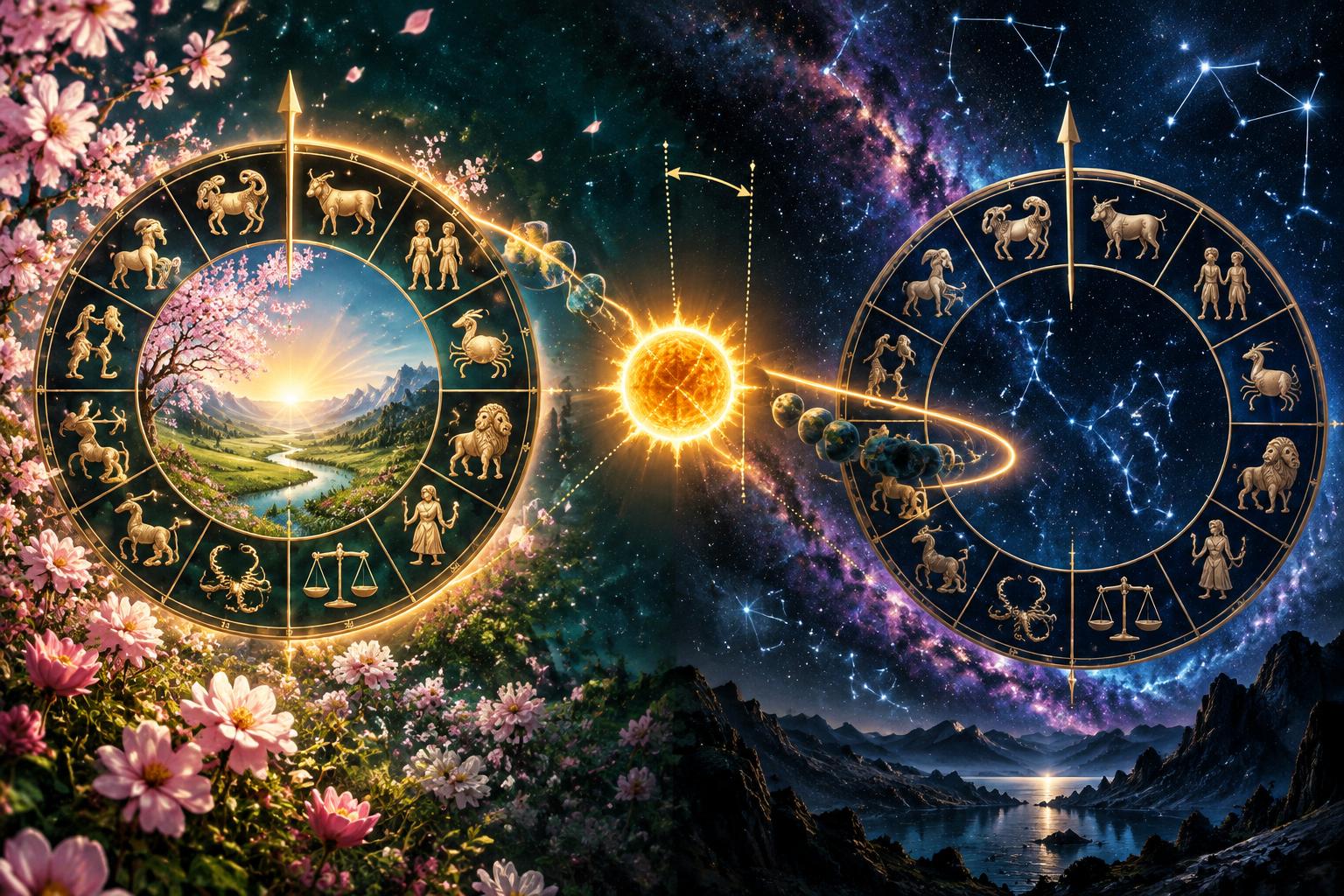
Perhaps you have thought of yourself as Leo all your life, but in your Vedic birth chart, the Sun appears in Cancer. Which calculation is correct? Both are correct within their own systems. They differ in where they place the beginning of the zodiac.
This is not a calculator error, and it does not mean you have become a different person overnight. It means that Western and Vedic astrology use two different coordinate systems.
The Tropical Zodiac Follows the Seasons
Most modern Western astrology uses the tropical zodiac. It places the beginning of Aries at the spring equinox in the Northern Hemisphere. This point marks the beginning of the astrological year and remains tied to the seasons.
The tropical zodiac is therefore not a direct map of today's constellations. It is a symbolic circle anchored in the relationship between the Earth and the Sun.
The Sidereal Zodiac Follows the Stars
Jyotish uses the sidereal zodiac. Its position is aligned with the background stars. The difference between the tropical and sidereal circles is called ayanamsha.
Magic Klara uses Lahiri ayanamsha in its calculations, one of the most widely used in Indian astrology. Today, the difference is approximately 24 degrees. For most people, this shifts the Sun back by roughly one sign in the sidereal calculation.
You can find a more detailed explanation on the Sidereal Zodiac page.
Why the Difference Developed
The Earth's axis is not entirely still. It slowly wobbles like a spinning top. This phenomenon is called the precession of the equinoxes. As a result, the spring equinox point gradually moves relative to the constellations over the centuries.
Nearly two thousand years ago, the tropical and stellar starting points of Aries were much closer together. Over time, the difference grew. The tropical system remained tied to the equinox, while the sidereal system accounts for the difference through ayanamsha.
Does the Sign Always Change?
No. If your tropical Sun is in the later degrees of a sign, it may remain in that sign in the sidereal zodiac. If it is in the earlier degrees, it usually moves into the preceding sign.
Different sidereal schools also use slightly different ayanamshas. Near a boundary, this can produce small differences. What matters is that the astrologer states which system they use and applies it consistently throughout the interpretation.
Why You Still Recognize Yourself in Your Western Sign
The Sun alone does not describe a person. You may have your ascendant, Moon, or several grahas—planetary forces—in the sign you know from your Western horoscope. You may also know its description well and have developed a personal language around it over the years.
Western and Vedic astrology also interpret the same symbols within different frameworks. Western psychological astrology may emphasize the development of identity. Jyotish also connects the Sun with atma, the soul, as well as vitality, the paternal lineage, authority, and dharma, your path of purpose and responsibility.
A change in Sun sign is therefore not a contest between two labels. It is an invitation to a wider perspective.
In Jyotish, the Sun Is Not the Whole Story
In a Vedic interpretation, we first connect the ascendant, Moon, Sun, and ascendant ruler. Then we look at the houses, nakshatras, and dashas. Your Moon's nakshatra may reveal more about your inner world than the Sun's position alone.
That is why “What is my zodiac sign?” has no one-word answer in Jyotish. You are not just a sign. You are a relationship between several forces whose voices grow stronger or quieter at different stages of life.
An Example, Not a Personal Forecast
A person may have their tropical Sun in Aries and their sidereal Sun in Pisces. A Western description may emphasize directness and a need for independence. A Vedic interpretation of the Sun in Pisces may speak of a search for meaning, sensitivity to the whole, and the way authority connects with faith or imagination.
This is not necessarily a contradiction. Courage can express itself through creativity. Independence can develop through working for something greater. The whole chart shows which connection is true for this person.
How to Check Your Sidereal Sign
Use a calculator that clearly specifies the sidereal zodiac and Lahiri ayanamsha. Enter your correct date, time, and place of birth. Then check the Sun, Moon, and ascendant, rather than just one placement.
On the free tools page, you can begin with your Moon's nakshatra and other basic calculations. To explore the meaning of each celestial force, visit the 9 grahas.
Two astrological charts do not represent two different people. They are two languages that map the same moment of birth using different coordinates.
The greatest clarity comes when you choose one system, understand its logic, and avoid mixing it randomly with another. Then the chart stops being a collection of labels and becomes a coherent story.
Related articles
What Is Jyotish, and Why Is It Different from a Magazine Horoscope?
Jyotish means the science of light. Rather than predictions, it offers a map: where your energy feels at home, where it is learning, and when doors begin to open.
Read BasicsHow to Read a Birth Chart: A Clear Sequence for Beginners
A simple sequence for reading a Vedic birth chart: from the ascendant and Moon to houses, grahas, nakshatras, and life periods.
Read BasicsWhy a General Horoscope Is Not Your Personal Forecast
A newspaper horoscope knows only one sign. A personal chart brings together the Moon, ascendant, houses, grahas, dashas, and current transits.
Read