Home/Library/How to Read a Birth Chart: A Clear Sequence for Beginners
Basics
How to Read a Birth Chart: A Clear Sequence for Beginners
A simple sequence for reading a Vedic birth chart: from the ascendant and Moon to houses, grahas, nakshatras, and life periods.
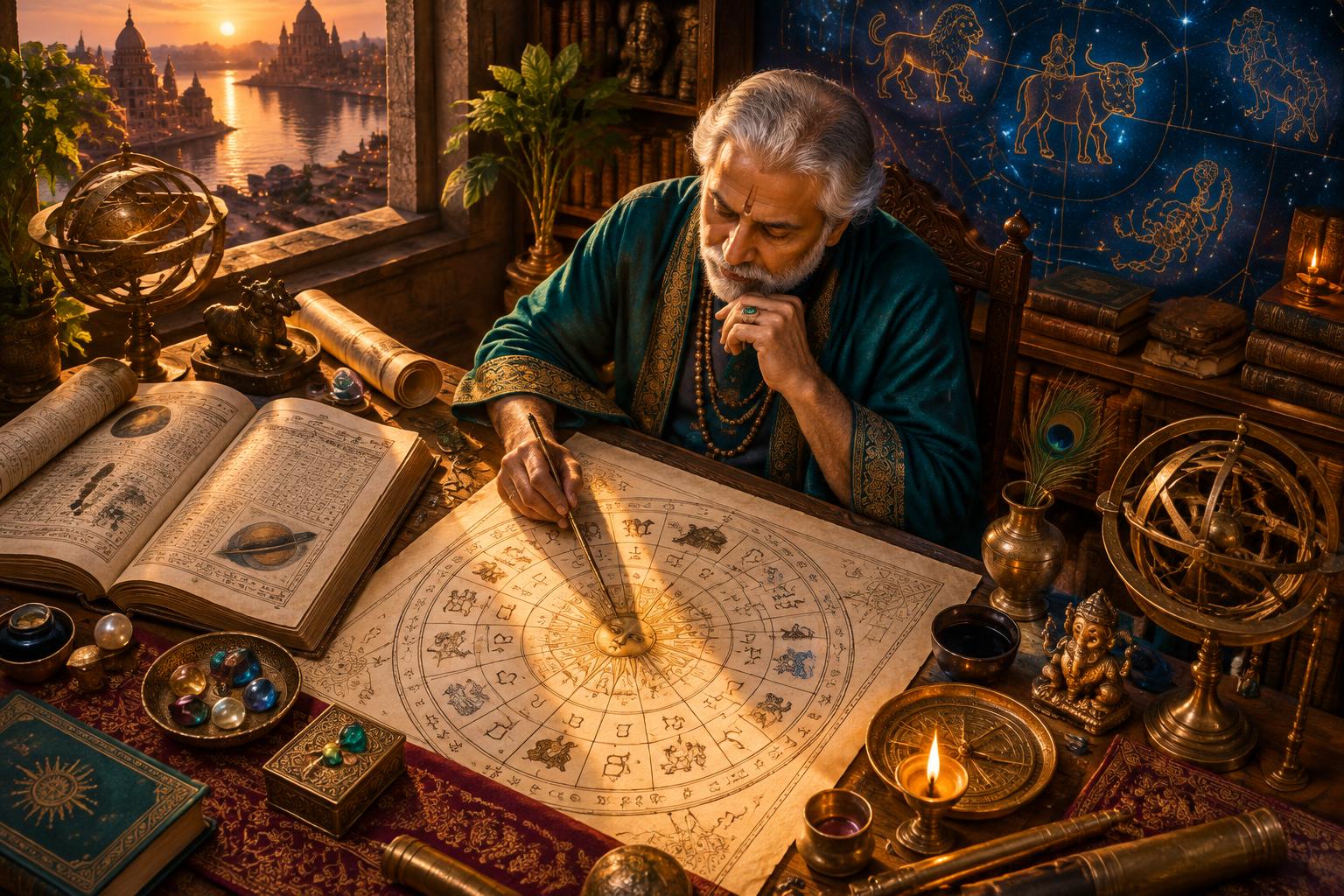
Reading a birth chart by jumping from one placement to another is rarely helpful. You quickly end up with a pile of disconnected descriptions. One says you are courageous. Another says you are cautious. A third says change lies ahead. All may be partly true, but without a sequence, there is no story.
The approach below is intended for beginners. You do not need to know every Sanskrit term already. You only need patience and a willingness to see the whole picture first.
1. Check Your Birth Details
Before interpreting the chart, check your date, place, and time of birth. A few minutes can change the degree of the ascendant; a larger difference can change the houses as well. If you do not know the exact time, be cautious about claims concerning the ascendant, houses, and timeline.
Do not adjust the time simply to make the chart fit your idea of yourself. Rectification is a separate process in which an astrologer compares important life events against several possible birth times.
2. Find the Ascendant and Its Ruler
The ascendant is the chart's starting point. First, look at its sign. Then find the graha, or planetary force, that rules that sign. Which house is it in? Which grahas is it connected to? Is it supported or under strain?
The ascendant ruler often shows where most of your life energy flows. If it is in the tenth house, identity is strongly shaped through work and responsibility. If it is in the fourth, home, roots, and inner steadiness matter. This is not a complete interpretation, but the first sentence of the story.
3. Get to Know the Moon
In Jyotish, the Moon describes manas: the feeling, responsive mind. Look at its sign, house, and nakshatra. The sign shows your style of emotional response. The house shows the area where you seek security. The nakshatra adds a deeper motivation and inner rhythm.
The Moon is especially important because its nakshatra is used to calculate the starting point of the Vimshottari dashas. It therefore connects your inner world with your life timeline.
4. Look at the Sun
The Sun shows your core, vitality, relationship with authority, and ability to stand in your own light. Do not immediately equate it with personality. In a Vedic chart, it is one of the main bearers of the story, not its only protagonist.
Compare the Sun, Moon, and ascendant. Where do they speak a similar language? Where do they differ? We are often most alive in the tension between these three points.
5. Read the Houses by Theme
Rather than looking at all twelve houses at once, choose a theme.
- For work and direction, look at the second, sixth, and tenth houses.
- For relationships, look at the second, fifth, seventh, and eighth houses.
- For home and inner peace, look at the fourth house and the Moon.
- For learning and meaning, look at the fifth and ninth houses, and Jupiter.
- For change and letting go, look at the eighth and twelfth houses.
For each house, check its sign, ruler, the grahas within it, and its aspects. A house without planets is not empty. It is still guided by a particular graha.
6. Understand Grahas in Relationship
Grahas do not act in isolation. A conjunction brings their themes together. An aspect creates a connection across a distance. An exchange of signs can closely intertwine two houses. It also matters whether a graha is in a sign where it can act steadily or in an environment that requires more adaptation.
To begin, write down three things for each graha: what it represents, which house it acts in, and what it rules. Then bring these together in one meaningful sentence. For example: “Mars directs my will toward learning, while also connecting home with creativity.”
7. Add the Nakshatras
Nakshatras are a subtle layer of the chart. Do not begin with all of them. First, look at the nakshatras of the Moon, the ascendant, and the ascendant ruler. Each has a symbol, deity, ruling graha, and a particular task of growth.
A nakshatra does not replace a sign. It shows how the sign expresses itself. The Moon in Taurus in Krittika operates differently from the Moon in Taurus in Rohini.
8. Only Then Look at Dashas and Transits
First, understand the birth chart. Then ask what is active now. Dashas show the major and subsidiary life periods. Transits show which external pressures or opportunities are currently activating the chart.
This helps you avoid a common mistake: interpreting a single transit dramatically without checking whether its theme has a strong foundation in the birth chart at all.
9. Look for a Recurring Theme
The most important themes repeat throughout a chart. If the same theme appears through the ascendant, Moon, tenth-house ruler, and current dasha, it deserves attention. One indication is interesting. Three independent indications form a pattern.
A Worksheet for Your First Reading
Write down:
- My ascendant is …, its ruler is …, and it is placed in the … house.
- My Moon is in the sign of … and the nakshatra …
- My Sun is in the … house and speaks of …
- The theme that repeats most often in my chart is …
- My current dasha emphasizes …
- One practical step I can take is …
Do not try to finish understanding the chart once and for all. A good interpretation deepens with experience. For a first introduction, use the free calculators; for a more detailed understanding, explore the comprehensive analysis.
Related articles
What Is Jyotish, and Why Is It Different from a Magazine Horoscope?
Jyotish means the science of light. Rather than predictions, it offers a map: where your energy feels at home, where it is learning, and when doors begin to open.
Read BasicsWhy a General Horoscope Is Not Your Personal Forecast
A newspaper horoscope knows only one sign. A personal chart brings together the Moon, ascendant, houses, grahas, dashas, and current transits.
Read BasicsHow Accurate Does Your Birth Time Need to Be for an Astrology Chart?
Why an accurate birth time matters, what can change within a few minutes, and what you can do if you do not know your birth time.
Read