Home/Library/The Vedic Birth Chart: A Map of the Sky at Your Birth
Basics
The Vedic Birth Chart: A Map of the Sky at Your Birth
What a Vedic birth chart actually shows, the parts it is made of, and why we do not read it as a list of unchangeable predictions.
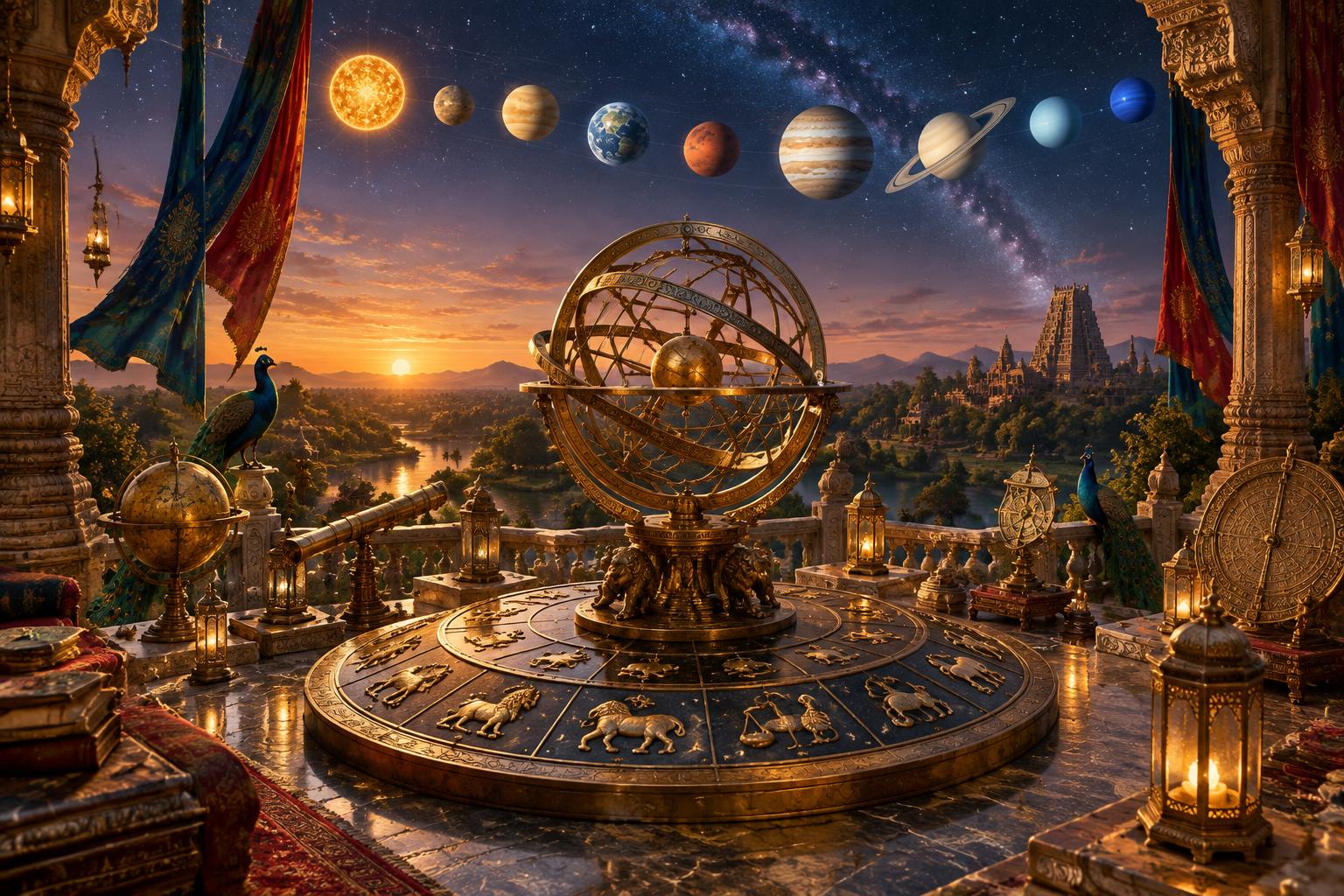
When you first look at a Vedic birth chart, you may see only a grid of compartments, unfamiliar symbols, and planetary names. But a chart is not a puzzle meant only for astrologers. It is a precise snapshot of the sky at the moment of your first breath. It shows which life themes were emphasized then and how they connect with one another.
In Jyotish, a birth chart is not a verdict. It is a map. A map does not decide where you will go, but it shows you the terrain, steep paths, open plains, and crossroads where it is wise to slow down.
What Is a Vedic Birth Chart?
Vedic astrology, or Jyotish, uses the sidereal zodiac. This is based on the actual positions of the constellations. Because sidereal and tropical calculations differ, the signs in a Vedic chart may differ from those you know from Western astrology.
To calculate the chart, we need three details: your date, the most accurate possible time, and place of birth. From these, we determine the rising sign, the positions of the nine grahas, the twelve houses, and the Moon's nakshatra. Each part answers a different question.
The Four Foundations of the Chart
The Ascendant: How You Enter Life
The ascendant, or lagna, is the sign that was rising on the eastern horizon. It describes the body, your fundamental orientation, how you begin things, and the perspective through which you experience the world. Because it changes approximately every two hours, your birth time is very important.
The Twelve Houses: Areas of Life
The houses show where something happens. The first speaks of you and your body. The fourth concerns home and inner security. The seventh concerns relationships. The tenth concerns work, responsibility, and visibility. No house is inherently good or bad. Each is a field of experience.
The Nine Grahas: Forces at Work
Grahas are not simply astronomical planets. In the chart, they represent living principles. The Sun speaks of your core and dignity, the Moon of the mind and emotional security, Mars of courage and boundaries, Mercury of thinking, Jupiter of meaning, Venus of relationships and values, and Saturn of time and responsibility. Rahu and Ketu are the lunar nodes. They show intense desire and the area where we learn to let go.
Explore all nine grahas and their meanings in each house.
Nakshatras: The Moon's Subtle Language
The twenty-seven nakshatras divide the zodiac into smaller lunar mansions. The Moon's nakshatra often describes your inner rhythm, emotional needs, and way of connecting with great precision. Calculate your nakshatra or explore all 27 nakshatras.
Why One Placement Is Never Enough
The statement “I have Saturn in the seventh house” is not yet a chart interpretation. The sign, house ruler, aspects, strength of the graha, nakshatra, and current life period all matter. A single symbol is always read in relation to the whole.
Online descriptions can therefore offer a good starting point, but they cannot replace synthesis. Two people may have the Moon in the same sign and entirely different life stories because other grahas support it or place it under strain.
The Chart Shows Potential; Dashas Show Timing
The birth chart describes your underlying potential. The Vimshottari dasha system shows which chapter is currently opening. The same career opportunity may develop quickly in one period and require more preparation in another. Read more on the Vimshottari dashas page.
Transits add the current weather. They do not erase the birth chart, but activate what is already possible within it. A good astrological reading therefore always connects natal potential, the life period, and current movements.
How to Use the Chart in Practice
Begin with one genuine question. Do not look for everything at once. If your question concerns work, look at the tenth house, its ruler, Saturn, the Sun, and the current dasha. For relationships, the seventh house, Venus, Jupiter, and the Moon's patterns matter. For inner peace, we look primarily at the Moon, the fourth house, and their connections.
Then compare the symbol with your life. Where do you already recognize it? Where are you expressing it maturely, and where are you acting automatically? Astrology becomes useful only when we translate a symbol into a decision, a conversation, or a new habit.
What the Chart Cannot Decide for You
The chart does not say that something must happen in one specific way. Nor does it determine your worth. It shows patterns, sensitive periods, and possibilities for growth. Free will is not the absence of circumstances. It is the quality of your response to them.
The best map is not the one that dictates your direction. The best map helps you see where you truly stand.
If you would like to explore the main themes yourself first, use the free tools. For an integrated interpretation of the whole chart, explore the comprehensive birth chart analysis.
Related articles
What Is Jyotish, and Why Is It Different from a Magazine Horoscope?
Jyotish means the science of light. Rather than predictions, it offers a map: where your energy feels at home, where it is learning, and when doors begin to open.
Read BasicsHow to Read a Birth Chart: A Clear Sequence for Beginners
A simple sequence for reading a Vedic birth chart: from the ascendant and Moon to houses, grahas, nakshatras, and life periods.
Read BasicsWhy a General Horoscope Is Not Your Personal Forecast
A newspaper horoscope knows only one sign. A personal chart brings together the Moon, ascendant, houses, grahas, dashas, and current transits.
Read