Home/Nakshatras/Mula
Nakshatra 19 · ruler Ketu
Mula
Mula
Mula means “root” and directs attention towards origins, the true cause, and what lies beneath the surface. It brings independence, investigative acuity, the ability to thoroughly dismantle the old, and the potential for deep spiritual devotion. Its path is not destruction for its own sake, but courageous honesty that makes it possible to rebuild life on firmer, more authentic foundations.
- Range
- 0°00′ Sagittarius – 13°20′ Sagittarius
- Ruler (dasha period)
- Ketu
- Deity
- Nirriti
- Symbol
- Bundle of roots
- Gana (temperament)
- Rakshasa (fierce)
- Keywords
- —
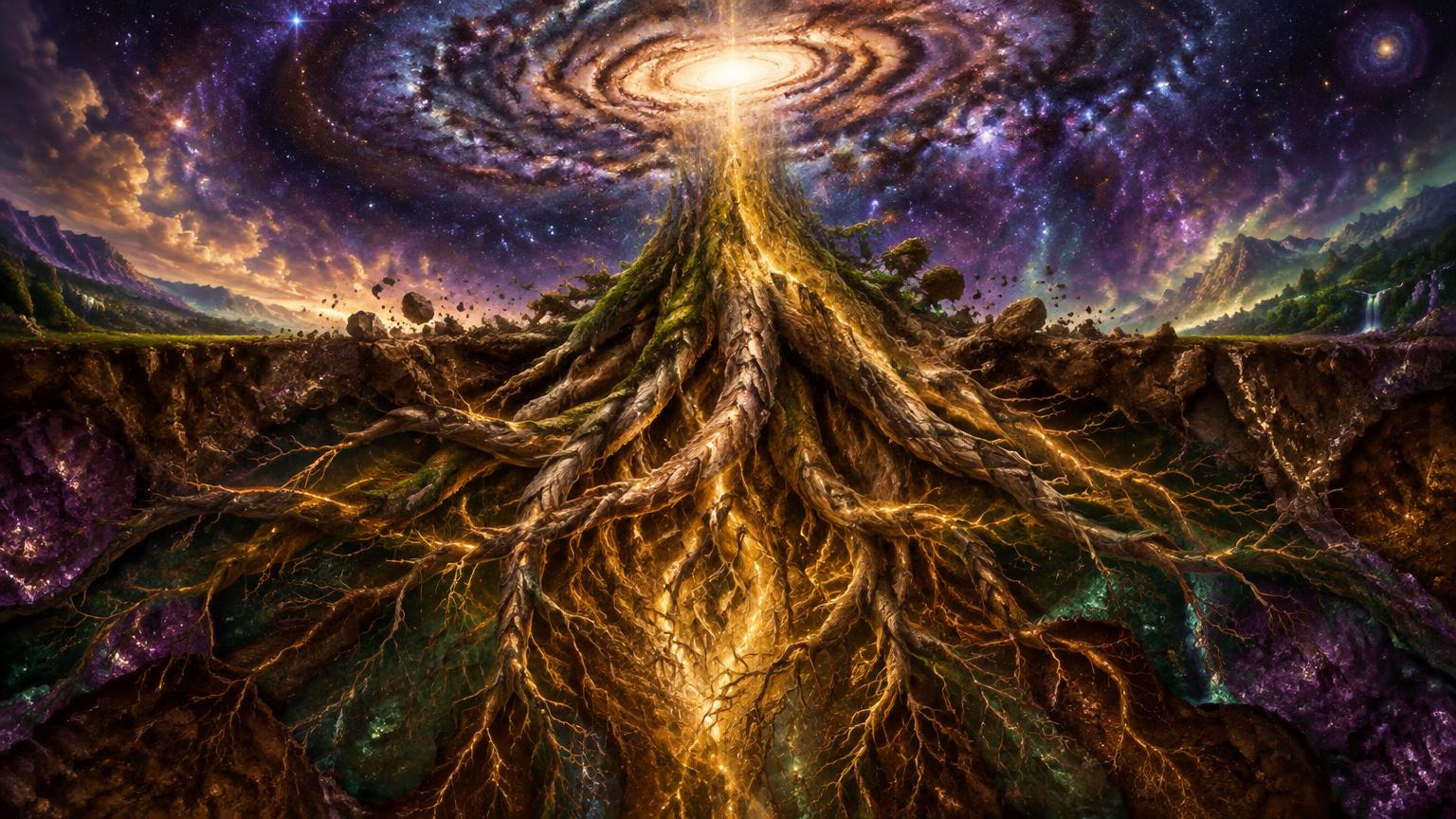
Mula – the courage to reach the roots
Mula is the nineteenth of the 27 nakshatras, or lunar mansions. It spans 0°00′ to 13°20′ Sagittarius in the sidereal zodiac. Its planetary ruler is Ketu, while Sagittarius is ruled by Jupiter. This connection brings together the need to dismantle appearances and the search for deeper meaning.
The name Mula means root, foundation, or origin. Its question is not simply what is happening. It wants to know why it is happening and where it began. A surface-level answer rarely satisfies it.
This is a nakshatra of investigation, discernment, and returning to what matters most. Its mature strength does not lie in tearing everything down. It lies in recognizing what no longer has a sound foundation and preserving what genuinely supports life.
Key facts
- Number: 19
- Span: 0°00′–13°20′ Sagittarius
- Nakshatra ruler: Ketu, the south lunar node
- Sign ruler: Jupiter, also known as Guru
- Deity: Nirriti
- Main symbol: a bundle of bound roots
- Shakti: Barhana shakti, the power to destroy or uproot
- Gana: rakshasa
- Guna: tamas
- Life motivation: kama, desire and fulfillment
- Animal symbol: dog
- Navamshas of the four padas: Aries, Taurus, Gemini, Cancer
Terms such as rakshasa and tamas are traditional symbolic categories. They do not imply bad character or moral inferiority.
Jyotish is a traditional system of interpretation, not a scientifically validated method of prediction. One nakshatra alone does not determine your career, health, relationship, or future. Its symbolism is best used for reflection, not as a verdict.
Nirriti – meeting what is falling apart
Mula’s deity is Nirriti. In Vedic tradition, she represents decay, disorder, and a departure from the order that holds life together. In later symbolism, she is also associated with the southwest direction. Her image is not comforting, but it raises an important question: what remains when external support fails?
Vedic prayers often express a wish to avoid her realm of dissolution. In interpretations of Mula, however, this mythological layer becomes an invitation to consciously face what is already losing its ability to support us. This is not a prediction of misfortune. It is an image of the limits of every constructed form.
A house can stand for a long time even when its foundation has weakened. Likewise, we may cling to a belief, role, or agreement that no longer reflects reality. Mula directs our attention precisely where we would rather not look.
There is therefore no need to soften Nirriti into a benevolent protector. Her symbolism remains challenging. Yet it teaches us to distinguish between something that needs restoration and something whose time has passed. Disintegration is not the goal. A clearer relationship with reality may be its meaning.
The symbol of bound roots
Mula’s main symbol is a bundle of bound roots. Roots are hidden, yet they nourish visible growth. A tree does not stand because of its crown. It stands because of its connection to the earth.
It matters that the roots are not shown as a single strand. They are intertwined. In the same way, a human difficulty rarely stems from just one event. A habit may be connected to family messages, fear, the surrounding environment, and entirely practical circumstances.
Mula wants to untangle these connections. At work, it may discover that delays are caused not by laziness but by unclear responsibilities. In a relationship, it may notice that an argument over something small conceals an unspoken need.
But the symbol also carries a warning. If we pull up the whole plant too quickly, we may destroy the healthy part. Mature Mula does not remove everything indiscriminately. First, it checks which root feeds the problem and which allows growth to continue.
Shakti – the power to uproot
Mula’s traditional power is called Barhana shakti. It is most often interpreted as the power to destroy, dismantle, or uproot. This means removing something at its source rather than merely correcting its visible effects.
In everyday life, this power can be very useful. Instead of repeatedly fixing the same mistake, a person changes the process that produces it. Instead of making new promises, they recognize the habit that keeps undermining those promises.
Shakti, or inherent power, does not in itself tell us whether an action will be wise. Even sharp analysis can become a weapon. Even honesty can be used to humiliate.
A mature expression therefore requires purpose, proportion, and responsibility. Before removing something, consider the consequences. Ask who will be affected and what will take over the supporting role of the structure being removed. Mula is most helpful when it removes the cause of confusion, not the security a person still needs.
Ketu in Sagittarius – from emptiness to meaning
Ketu is Mula’s ruler. In Jyotish, it symbolizes separation, non-attachment, internalized experience, and dissatisfaction with external validation. Sagittarius, under Jupiter’s guidance, seeks meaning, knowledge, ethics, and a broader perspective.
The expression Ketu in Sagittarius here describes the connection between the nakshatra’s ruler and the sign. It does not mean that everyone with a strong Mula emphasis also has natal Ketu in Sagittarius.
Ketu can strip away certainty. Jupiter tries to turn experience into understanding. Together, they raise a question: if the old answer no longer holds, how can I seek a new one without inventing another absolute truth?
A mature connection supports independent thinking and a willingness to examine one’s own beliefs. A person can respect a teacher without surrendering their own judgment.
The shadow appears as cynicism or dogmatism. The first claims that nothing has meaning. The second demands a single answer. Balance emerges when we allow uncertainty while remaining responsible for our practical decisions.
Inner life and character
A strong Mula emphasis may symbolically highlight an investigative outlook. A person notices inconsistencies and finds it hard to let go of a question that has not yet received a satisfying answer. They are interested in the background, not just the official explanation.
Outwardly, they may be direct, unassuming, or surprisingly relaxed. Depth does not necessarily mean solemnity. Humor, too, can be a way to expose self-importance, pretense, or a pointless rule.
Common qualities of a mature expression include:
- a willingness to ask an uncomfortable but necessary question;
- independence in forming beliefs;
- persistence in investigation;
- the ability to let go of what is unnecessary;
- sensitivity to the difference between appearance and substance;
- the courage to revise one’s own position.
Such a person often needs room to examine things independently. But independence is not the same as refusing help. A thoughtful conversation partner can deepen their inquiry without restricting it.
Mula’s gifts
Penetrating inquiry
Mula does not stop at the first answer. It can connect details and look for the cause of a recurring pattern. This gift becomes especially useful when intuition is checked against facts and the possibility of being wrong remains open.
The courage to face the truth
It can raise a subject that others avoid. The mature form of this gift is not harshness. It is the willingness to say something important clearly, at the right time, and with respect for the person receiving it.
Simplification
It recognizes what has become an unnecessary complication. It can streamline a process, reduce excessive commitments, or draw the essentials from a large body of material. This frees attention for what actually works.
Inner independence
External recognition is not always enough for Mula. It seeks consistency between stated values and actual behavior. This can support integrity even when a group expects unquestioning conformity.
The ability to begin again
When something stops serving its purpose, Mula can find a different foundation. The gift is not in constantly starting over. It is in being willing to use what has been learned rather than defending an ineffective solution out of pride.
Shadow sides and inner challenges
The same sharpness that clarifies a problem can cut through something precious. Mula may confuse thoroughness with overanalysis and freedom with continually walking away.
Common challenges include:
- looking for a hidden problem even where there is none;
- tearing things down without a plan for what follows;
- being direct without a sense of timing;
- rejecting authority simply because it is authority;
- an excessive need for a definitive answer;
- distancing oneself from feelings through constant analysis.
The key question is: Am I seeking the truth, or merely a reason not to trust?
Maturity also means knowing when to stop digging. Not every ambiguity is deception. Not every imperfect arrangement is unworthy of preservation. Sometimes the most radical change is to stay, explain a need, and patiently repair something.
The four padas – four modes of expression
Each pada, or quarter, spans 3°20′. Its navamsha, a ninth-harmonic division, shows an additional mode of expression. The ranges below apply to sidereal Sagittarius. The meaning must always be adapted to the graha, or planetary factor, the house, and the chart as a whole.
1st pada: 0°00′–3°20′ Sagittarius · Aries navamsha
The first pada is ruled by Mars through Aries. It emphasizes initiative, directness, and readiness to act. Investigation quickly turns into testing. A person wants to find out what works and struggles to settle for a discussion without a conclusion. The gift is the courage to raise a question that others keep postponing.
The challenge is cutting too quickly. A feeling of clarity does not mean that all the consequences have been examined. It helps to distinguish an urgent decision from a passing impulse. A mature first pada directs its strength toward a specific problem rather than rejecting an entire project or relationship because of one obstacle.
2nd pada: 3°20′–6°40′ Sagittarius · Taurus navamsha
The second pada belongs to Venus-ruled Taurus. Values, resources, sensory experience, and the need for a stable foundation come to the foreground. Here, Mula explores what truly nourishes it. This may mean a thoughtful relationship with possessions, work, nature, or the quality of everyday life.
Tension arises between the need for security and the willingness to let go of what is unnecessary. A person may hold on too long because of money already invested or the comfort involved. A mature expression preserves healthy support, not every old attachment. It helps to ask whether something supports life today or merely validates a decision made in the past.
3rd pada: 6°40′–10°00′ Sagittarius · Gemini navamsha
The third pada is ruled by Mercury through Gemini. Curiosity finds language, questions, and the ability to compare. Researching sources, explaining complex subjects, and connecting different perspectives are emphasized. A person may notice an inconsistency in a story that others miss.
The shadow is scattered thinking or debate for its own sake. Constant doubt can prevent any conclusion. A mature third pada knows how to distinguish between a fact, an assumption, and an opinion. It helps to give the investigation a clear question and set a point at which the knowledge gathered will be translated into a useful decision.
4th pada: 10°00′–13°20′ Sagittarius · Cancer navamsha
The fourth pada belongs to the Moon through Cancer. The search for roots turns toward belonging, memories, family stories, and a sense of home. A person may readily perceive how past experiences shape present reactions. The gift is bringing understanding together with tenderness.
The challenge arises when the past becomes the only explanation for the present. Not every family rule is a burden, and not every change is a betrayal. A mature expression allows love to be preserved while a harmful arrangement is changed. It is helpful to build sources of security in the present rather than expecting that clarifying the past will resolve everything.
Moon in Mula
A natal Moon in Mula may symbolically describe an emotional need for honesty and an understanding of what lies beneath the surface. Reassuring words without substance may not be enough. Knowing what is really happening matters.
Uncertainty may bring a strong urge to investigate. This is useful as long as the questions bring clarity. If they become endless checking, however, they can distance a person from their immediate feelings.
Security is therefore not built through answers alone. It is also built through dependable people, clear agreements, and permission not to know everything right now.
Mula lies at the transition from Scorpio to Sagittarius, associated with the traditional concept of gandanta, a sensitive junction between water and fire signs. This emphasis refers to the boundary area, not the entire nakshatra, and it is not a mark of an unhappy destiny.
When interpreting the Moon, we consider its house, aspects, Jupiter, Ketu, and the rest of the chart.
Relationships and intimacy
Mula seeks authenticity in relationships. It is hard to satisfy with an arrangement that looks good from the outside but that no one actually lives by at home. It wants space for honest conversation, even when that is uncomfortable.
Its directness can be refreshing. A partner or friend does not have to guess what it thinks. But intimacy is not an interrogation. The right to honesty does not mean the right to demand immediate disclosure of everything.
Its growth in relationships involves three tasks:
- Ask without accusing. An observation should not become a premature judgment of another person’s intentions.
- Name the feeling before offering an analysis. “That hurt me” often opens more space than an account of everything that went wrong.
- Distinguish a boundary from an ending. Some relationships need a new agreement, not necessarily a departure.
When violence or coercion is present, safety and appropriate help take priority. Astrological symbolism is not a reason to remain in danger. Nor can the compatibility of two people be reliably judged from their nakshatras alone.
Work, career, and money
Mula’s investigative archetype can fit well with tasks that involve discovering a cause, testing assumptions, or renewing a system. The opportunity to ask questions matters.
Possible areas of expression include:
- scientific research and data analysis;
- auditing, quality assurance, and error detection;
- programming and technical troubleshooting;
- research-based writing and editorial work;
- history, archival studies, and the study of origins;
- organizational renewal and strategic consulting;
- work with soil, plants, or environmental restoration.
These are not predetermined careers. Interest, knowledge, training, and real opportunities are needed. In an astrological interpretation, we also consider the tenth house, its ruler, and other important factors.
With money, Mula may support simplicity and the reduction of unnecessary expenses. Its shadow is extremism: suddenly giving everything up or taking risks out of a conviction that a complete turnaround must follow.
Reviewing commitments, maintaining a realistic reserve, and making gradual changes can help. Financial decisions should not be based solely on a nakshatra or a current transit.
When Mula works through other grahas
Each graha brings the symbolism of roots into a different area.
- The Sun raises the question of identity without relying on a title or status.
- Mercury emphasizes investigative language, checking claims, and precise questions.
- Venus explores values, intimacy, and the difference between desire and genuine connection.
- Mars adds the strength to remove obstacles; its sharpness needs to be used thoughtfully.
- Jupiter examines beliefs and seeks an ethical framework that holds up in real life.
- Saturn directs attention toward foundations, responsibility, and the long-term consequences of change.
- Rahu may intensify the hunger for hidden explanations and for crossing established boundaries.
- Ketu emphasizes non-attachment and the need to reach the essence, but also the risk of disconnection.
These are symbolic starting points, not guaranteed traits. The house, the graha’s dignity, its connections, and the placements of Ketu and Jupiter all matter. The same nakshatra therefore does not express itself identically in everyone.
A natal nakshatra, a transit, and a dasha are not the same
A natal placement means that the Moon, another graha, or the ascendant was in Mula at birth. Within Jyotish, it is understood as a more enduring symbolic emphasis. It is always read alongside the whole chart.
A transit is a graha’s current passage through Mula. The Moon stays there for approximately one day, while slower grahas remain longer. Such a passage can be used as a reminder to review foundations, organize documents, or investigate something. By itself, it does not predict a loss, a separation, or a specific event.
A dasha is a planetary period within a chosen timing system. In the Vimshottari system, a natal Moon in Mula means that the initial mahadasha, or major period, belongs to Ketu. The remaining portion depends on the Moon’s exact position within the nakshatra.
Ketu’s dasha is not the same as a transit through Mula. Nor does it necessarily mean that natal Ketu is placed there. Interpreting the period involves its natal placement, connections, and subperiods. None of these three layers alone maps out a person’s future.
The spiritual and karmic lesson
Mula’s central lesson is to reach the root without losing respect for the life above it.
The search for truth can become a new form of control. A person wants to explain every feeling, remove every uncertainty, and prove that they have finally understood everything. Yet even the need for a complete explanation can be gently released.
In this context, karma can be understood as the interplay of actions, habits, and consequences. There is no need to assume punishment or a debt from past lives. A more useful question is which response we are repeating today and what we could do differently.
Mula develops from destruction driven by disappointment toward discernment guided by clarity. From rejecting all support toward choosing healthy support. From criticism alone toward responsible creation.
Its spirituality becomes convincing when dismantling leaves behind greater honesty, care, and willingness to cooperate.
Practical ways to find balance
Investigate one cause
Choose one recurring problem. Write down the facts, possible causes, and what you do not yet know. Do not assume there must be a single hidden answer. Identify the smallest change you can safely test.
Pause before making a cut
When safety is not at risk, do not make a major break solely in a moment of anger. Sleep on the decision. Consider the consequences, commitments, and other options. Clarity often becomes more useful once the initial intensity has eased.
Preserve the healthy root
When making a change, list what you want to keep. This might be knowledge, a relationship, a routine, or a source of income. Renewal then becomes not just a list of rejections, but also the conscious protection of what works.
Return to something tangible
After a long period of thinking, do something simple. Cook a meal, clear your desk, or go for a walk. This is not a promise of healing. It is a way to redirect attention toward a present activity with a clear beginning and end.
Practice honesty with consent
Before a difficult conversation, ask whether it is a good time. Share an observation, a feeling, and a request. Instead of interpreting the other person’s character, describe a specific action. This makes it easier for directness to become cooperation.
Keep spiritual practices a free choice
Silence, journaling, or a mantra can be voluntary forms of focus. They are not mandatory protection against Mula. Gemstones and rituals have no proven power to change destiny and are not substitutes for professional help.
Questions for self-reflection
- Which problem am I fixing on the surface without examining its source?
- What do I want to remove, and what must remain protected in the process?
- When do I use questions to understand, and when do I use them to control?
- Which belief am I willing to change in the light of new facts?
- What support do I need before making a major change?
Frequently asked questions
Is Mula a dangerous nakshatra?
No. Its challenging symbolism does not imply a dangerous person or predetermined losses. One nakshatra cannot tell us whether someone’s life will be safe. Frightening interpretations often confuse a mythological image with a literal prediction.
Does being born in Mula harm the family?
There is no sound basis for such a claim. It is inappropriate to burden a child or an adult with guilt because of the Moon’s placement. Family life is shaped by actual relationships, circumstances, and people’s behavior, not by a nakshatra label.
Does Mula require giving up material life?
No. Non-attachment is not neglect of money, home, or responsibilities. It can mean a simple relationship with possessions and the ability to change a plan. A stable material foundation can, in fact, allow greater freedom to explore.
Why does the exact pada matter?
The pada adds a mode of expression: Aries brings initiative, Taurus stability, Gemini investigative language, and Cancer emotional roots. An exact sidereal position is needed to identify it. A pada’s navamsha is not the same as the sign in the main natal chart.
How do I know whether Mula is prominent in my chart?
Check whether the Moon, ascendant, or important grahas are placed there. Then consider their houses, connections, Ketu, and Jupiter. For placements near a boundary, accurate birth data and the chosen ayanamsha—the offset used to calculate sidereal positions—matter.
In closing
Mula does not seek depth in order to make life harder. Its most useful symbolism speaks of the simplicity that emerges after an honest examination of the foundations.
Sometimes something needs to be released. At other times, that same thing needs to be understood more fully and cared for. Wisdom lies in knowing the difference.
The bound roots remind us that nothing grows entirely on its own. Every change touches a wider web of relationships, habits, and responsibilities.
Mature Mula therefore asks not only: what must I remove? It also asks: what do I want to nurture afterward? It is in this second question that its sharpness becomes clear, responsible strength.
Which nakshatra is yours?
Enter your date, time and place of birth — the calculation is free.
Calculate your nakshatra