
Home/Nakshatras/Dhanishtha
Nakshatra 23 · ruler Mars
Dhanishtha
Dhanishtha
Dhanishtha is the star of symphony, and its drum symbol speaks of rhythm, music, time, and a shared pulse. It supports courage, charity, ambition, material resourcefulness, and the ability to unite people around a common goal. Its path is to harmonise its own pace with its relationships, so that determination does not become haste and success does not overshadow emotional closeness.
- Range
- 23°20′ Capricorn – 6°40′ Aquarius
- Ruler (dasha period)
- Mars
- Deity
- Vasuji
- Symbol
- Drum
- Gana (temperament)
- Rakshasa (fierce)
- Keywords
- —
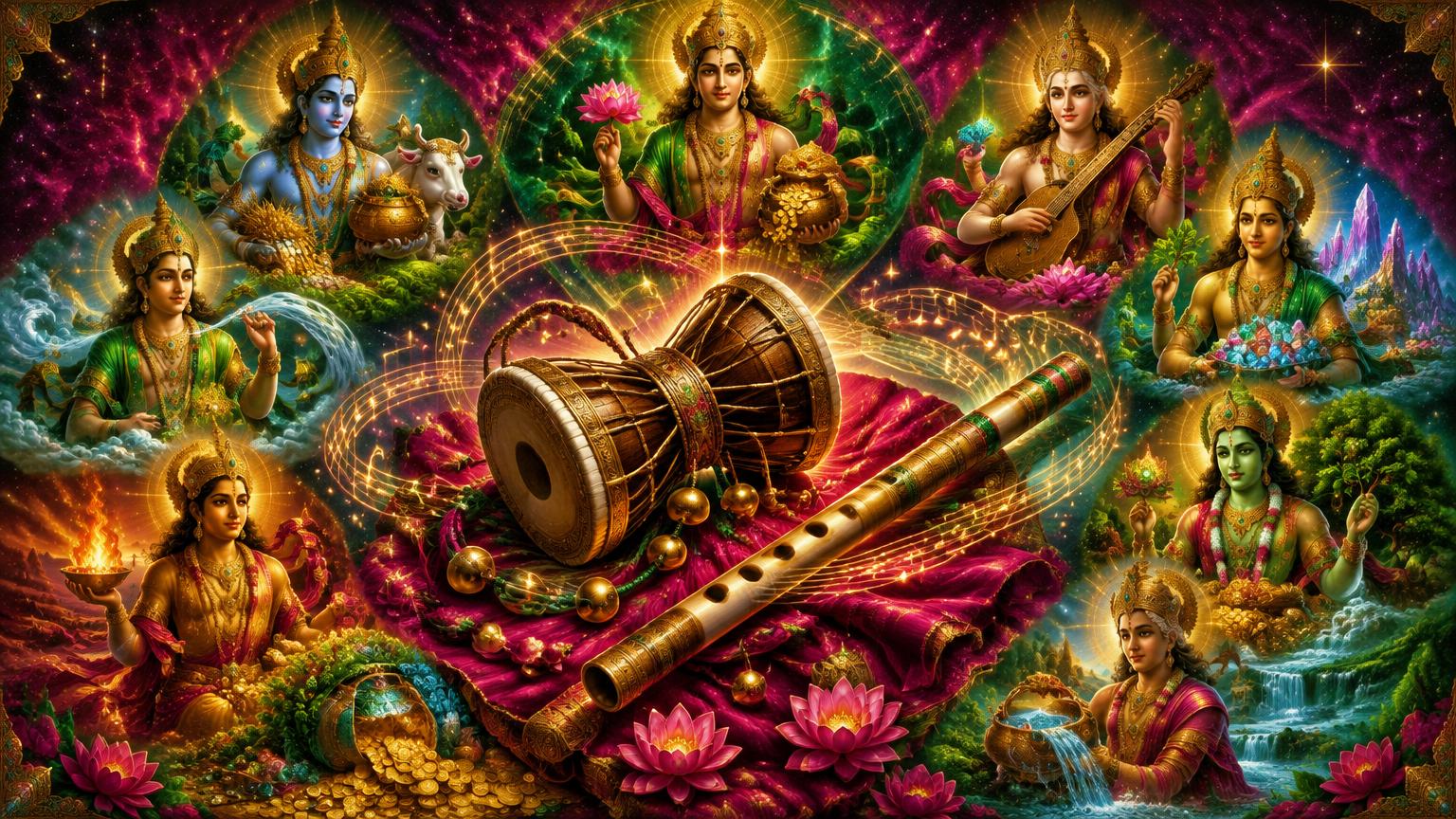
Dhaništa – the rhythm that connects strength and abundance
Dhaništa is the twenty-third of the 27 nakshatras, or lunar mansions. It extends from 23°20′ Capricorn to 6°40′ Aquarius. Its planetary ruler is Mars, while both signs are ruled by Saturn in traditional Jyotish, or Vedic astrology.
Its central theme is rhythm. Not only musical rhythm, but also a sense of timing. When to step forward. When to listen. When to bring individual abilities together into something no one could create alone.
Dhaništa connects action, material resources, and belonging. It can speak of achievement and recognition, but its deeper value does not lie in applause. It lies in the ability to make personal strength a useful part of shared life.
Essential information
- Number: 23
- Span: 23°20′ Capricorn–6°40′ Aquarius
- Nakshatra ruler: Mars, or Mangala
- Ruler of both signs: Saturn, or Šani
- Deities: the eight Vasus
- Main symbol: drum
- Additional symbol: flute
- Shakti: Khyapayitri shakti, the power of abundance and recognition
- Element: ether
- Guna: tamas
- Life motivation: artha, material support and accomplishment
- Animal symbol: lion
This span applies to the sidereal zodiac used in Jyotish. Determining a placement requires an accurate calculation and a chosen ayanamsha, the offset used to align the zodiac.
These are traditional symbolic categories, not scientific measurements of personality. They suggest themes for reflection, not definitive human traits.
The eight Vasus – the wealth that sustains life
The deities of Dhaništa are the Vasus, eight divine forces associated with natural phenomena and the fundamental supports of the world. Their name is linked to wealth, resources, and that which makes existence possible. The lists vary somewhat between traditions.
They are often named as Dhara, the support of the earth; Dhruva, the constancy of the North Star; Soma, lunar nourishment; Aha, day; Anila, wind; Anala, fire; Pratjuša, dawn; and Prabhasa, light or radiance.
Together, they show that wealth is not only money. It is also space, time, warmth, movement, food, and a sense of direction. None of these forces is sufficient on its own.
In a well-known story from the Mahabharata, the Vasus take part in stealing the miraculous cow of the sage Vasištha. As a consequence, they must take human birth. Ganga becomes their mother and quickly releases seven of them from earthly existence. The eighth, who bears the main responsibility, remains as Bhišma.
The myth raises questions about desire, collective responsibility, and duty. Cooperation does not remove the need for personal judgment. Even a capable group can lose its way if it does not examine its intentions.
Bhišma’s long fidelity to his vow reveals another side. Perseverance is a great strength, but a promise also needs ongoing ethical discernment. The symbolism of Dhaništa therefore does not glorify success at any cost. It asks whom power serves and what consequences it leaves behind.
Drum and flute – sound needs space
The drum creates a pulse around which a group can coordinate. Its sound gathers attention. It can accompany celebration, movement, or shared work. In Dhaništa, it represents the ability to organize energy and give events a clear tempo.
A drum also needs an empty space within. If we fill it completely, it loses its distinctive resonance. Likewise, it is difficult to create when every hour is filled with obligations and the need to prove ourselves.
The flute emphasizes breath, listening, and precision. Volume alone does not create a melody. Sensitivity, pauses, and responsiveness are needed.
Both symbols speak of action working together with openness. Dhaništa does not simply need more force. It needs space through which that force can find meaningful expression. In practice, this means less rushing between tasks and more attention to their sequence.
Shakti – abundance that becomes visible
Dhaništa’s power is called Khyapayitri shakti. It is usually understood as the power to bring abundance, fame, or recognition. Fame need not mean public celebrity. It can mean a good reputation, trust, or an acknowledged contribution.
This shakti connects ability with its impact in the world. Someone develops a skill. They demonstrate it at the right time. Others recognize the usefulness of their work. Cooperation, opportunities, and an exchange of resources emerge in this way.
Abundance here does not mean guaranteed wealth. It may be a richness of knowledge, friendships, creativity, or a well-organized environment.
An unbalanced expression seeks attention above all. A person shapes their work around what will be noticed and neglects what is genuinely needed. A mature expression reverses the order: first a valuable contribution, then recognition. Visibility becomes a consequence, not the sole measure of worth.
Mars from Capricorn into Aquarius
Mars brings initiative, courage, competitiveness, and the ability to act. Saturn, the ruler of both signs occupied by Dhaništa, adds rules, limitations, and long-term responsibility. Their meeting raises a question: how can strength be directed in a way that is also sustainable?
In Capricorn, the emphasis leans toward execution, structure, and achievement. The energy seeks to build, organize, or complete something. Reliability, standards, and a clear division of tasks matter.
In Aquarius, the perspective widens toward groups, networks, and shared systems. Personal achievement meets a different question: how will it benefit a wider circle of people?
This is not a description of an actual transit of Mars, but of the change in sign background within the nakshatra. Mars remains its ruler in both portions.
Mars is traditionally exalted in Capricorn. However, this does not make the Moon or Venus exalted when placed in the Capricorn portion of Dhaništa. Dignity always belongs to the particular graha, or planetary factor. Even a strong Mars does not, by itself, guarantee mature behavior; how its strength is used requires discernment.
Inner life and character
A prominent Dhaništa can symbolize someone who quickly senses the pace of their surroundings. They notice who is leading, where work is stalling, and what would bring a group together. They often feel comfortable moving toward a clear goal.
Outwardly, they may be sociable and effective. Inwardly, however, they may wonder whether they still belong when they are not contributing anything. This is where the important distinction between usefulness and personal worth lies.
Possible expressions include organizational ability, enterprise, creative sensitivity, and the capacity to respond well in demanding moments. Yet Dhaništa is not necessarily loud or showy. A quiet person can also hold the rhythm of an entire group.
The gifts of Dhaništa
A sense of timing
It can sense when preparation is good enough and the time has come to act. The gift is not merely speed, but alignment between circumstances and response.
Organizing collective energy
It can bring different people and tasks together into a functioning whole. In doing so, it recognizes that not everyone needs the same role or the same pace.
The courage to put ideas into practice
It wants to test an idea in practice. When the goal is clear, it can show considerable determination and a willingness to take responsibility for the next step.
Creative sensitivity
The symbolism of musical instruments supports an understanding of rhythm, repetition, and patterns of expression. This may appear in music, language, design, movement, or the creation of clear, well-structured systems.
Managing resources
Dhaništa can recognize what is already available. Rather than constantly seeking new resources, it can make better use of time, knowledge, space, and money.
Encouraging cooperation
In its mature expression, it helps others find a place where they can contribute. Its leadership calls for participants, not an audience. It takes pleasure in success where credit is shared fairly.
Shadow sides and inner challenges
Rhythm can become compulsion. A person keeps going because they fear that stopping will cost them their advantage or significance. An achievement brings brief satisfaction, then the benchmark immediately shifts.
Common shadow expressions include:
- measuring personal worth against other people’s success;
- impatience with slower decision-making;
- excessive busyness that conceals emotional needs;
- controlling a group in the name of efficiency;
- spending to make an impression or fit in;
- difficulty accepting help;
- resentment when effort goes unnoticed.
The distinction between cooperation and competition for status is especially important. If one person must always set the pace, others have no room to contribute in their own way.
A useful question is: Am I building something worthwhile, or mainly trying to prove that I am worthy?
The answer does not require abandoning ambition. It calls for a broader measure of success that also includes the quality of relationships, fairness, and the opportunity to rest.
The four padas – four ways of expressing this energy
Each pada, or quarter, spans 3°20′. The first two are in Capricorn, and the other two are in Aquarius. Their navamshas, the ninth-divisional signs, are Leo, Virgo, Libra, and Scorpio, respectively. A pada adds detail to an interpretation; it does not replace the full chart.
1st pada: 23°20′–26°40′ Capricorn · Leo navamsha
The first pada combines Capricorn’s focus on execution with Leo’s creative confidence. The navamsha ruler is the Sun. Initiative, authorship, and the desire to stand responsibly behind one’s work may be emphasized.
The gift is clear leadership that gives a group direction. The shadow emerges when disagreement becomes a personal insult. A useful practice is to acknowledge other people’s contributions publicly and ask whether the goal would still matter without personal praise. Authority can then grow from actions rather than a demand for special status.
2nd pada: 26°40′–30°00′ Capricorn · Virgo navamsha
The second pada adds Mercury’s precision, analysis, and ability to improve processes. Rhythm becomes method. A person may be drawn to data, technology, organizing, or attending to the details that allow the whole to function.
The gift is turning a large goal into manageable steps. The challenges are excessive correcting and a sense that nothing is good enough yet. Defining a standard for completion in advance can help. Quality remains important without preventing the delivery of work or relaxed cooperation.
3rd pada: 0°00′–3°20′ Aquarius · Libra navamsha
The third pada connects Aquarius’s community-minded perspective with Venus’s sense of exchange, beauty, and fairness. It pays greater attention to agreements, networking, and how people feel within a shared space.
The gift is creating cooperation in which different parties benefit. The shadow is accommodating others to gain acceptance or avoiding a clear decision. Balance requires specific agreements about time, money, and responsibility. A pleasant relationship is no substitute for a fair division of work.
4th pada: 3°20′–6°40′ Aquarius · Scorpio navamsha
The fourth pada has a Mars-ruled navamsha. It adds intensity, an investigative instinct, and sensitivity to hidden power dynamics to the group-oriented outlook. A person may notice problems that more superficial agreements cannot resolve.
The gift is the courage to address the heart of a complicated process. The challenges are distrust, testing loyalty, and trying to control every outcome. It is useful to distinguish facts from assumptions and ask direct questions. Depth becomes helpful when it creates greater clarity, rather than more hidden tests.
The Moon in Dhaništa
A natal Moon in Dhaništa may indicate an emotional need for rhythm, activity, and a sense of inclusion. Security is often built through reliable habits, shared projects, or people with whom something can be created.
A person may express affection in practical ways. They organize a gathering, lend a hand, or sort out a complicated task. Yet action does not always communicate everything they feel. Those close to them may also need words and simple presence.
When uncertain, they may become even busier. This keeps them effective, but makes it harder to notice disappointment, sadness, or the need for support. A useful question is: what would I feel if I did not take immediate action now?
The Capricorn portion may emphasize reserve and responsibility, while the Aquarius portion may emphasize a need for space and community. These are only possible tones. The Moon’s house, aspects, the placements of Mars and Saturn, and the rest of the chart all matter.
Relationships and intimacy
Dhaništa brings energy, initiative, and a willingness to build a shared life into a relationship. Feeling that two people are a team often means a great deal to it. A shared goal can bring people closer, but a relationship should not become merely a list of completed tasks.
Its three relationship tasks are:
- Express a need without trying to prove your worth. Rather than making an extra effort in the hope that it will be noticed, say clearly: I need more time, support, or tenderness.
- Allow a different pace. The other person may need time to think before answering. A slower response does not necessarily mean indifference or rejection.
- Separate closeness from achievement. Spend time together without a practical objective. Listen without trying to fix things, and accept help without feeling indebted.
Traditional claims that this nakshatra inevitably brings marital difficulties are not a sound basis for a personal conclusion. One nakshatra does not determine the quality or longevity of a relationship.
Even an astrological comparison requires both charts. In everyday life, what matters most is communication, safety, boundaries, and how disagreements are handled.
Work, career, and money
Dhaništa’s symbolism can find a natural expression in work that combines rhythm, execution, and cooperation. Examples include project management, logistics, technical work, entrepreneurship, event organization, music, production, or managing shared resources.
These are not prescribed careers. The same abilities are useful in skilled trades, education, public services, or the home. The essential question is how a person organizes their contribution, not what title they hold.
With money, there may be an ability to recognize opportunities and pool resources. The shadow is linking financial standing to personal worth. A purchase then responds not to a need, but to comparison.
Keeping track of income, making clear agreements, and maintaining a reserve for unexpected costs can help. In a shared project, contributions, payment, and ownership should be agreed in advance.
The nakshatra alone does not determine a career or level of wealth. Even within Jyotish, the second and eleventh houses, the tenth house, their rulers, the relationships between grahas, and planetary periods are considered. Decisions also need real-world information.
When Dhaništa works through other grahas
A graha shows which life function is expressed through the symbolism of the nakshatra.
- Sun: identity through achievement, leadership, or a useful public contribution; the challenge is dependence on recognition.
- Mercury: organized thinking and a sense for patterns and coordination; patient listening is also needed.
- Venus: enjoyment of music, social connection, and creating together; it explores the difference between closeness and social standing.
- Mars: strong initiative and energy for execution; it is important not to let competitiveness take over every relationship.
- Jupiter: sharing knowledge, mentoring, and distributing resources; generosity needs thoughtful boundaries.
- Saturn: steadily building systems and taking responsibility; the risk is measuring life solely by duties.
- Rahu: a heightened desire for reach, influence, or inclusion in important networks; motives need to be examined.
- Ketu: stepping away from conventional measures of success or a more inward sense of rhythm; practical participation remains important.
None of these descriptions stands alone. The graha’s sign, house, dignity, and relationships can substantially change its expression.
Natal placement, transit, and dasha are not the same
A natal placement means that the Moon, another graha, or the ascendant was in Dhaništa at birth. In an astrological interpretation, it represents a more enduring symbolic theme, but each placement speaks to a different area. A natal Moon is not the same as a natal Mercury.
A transit is a graha’s current passage through this span. The Moon’s passage is brief. You can use it symbolically as a reminder to coordinate your schedule, work with a group, or engage in a creative practice. It does not mean that everyone will experience the same events on the same day.
A dasha is a period within a chosen system of planetary periods. In the Vimshottari system, the Moon in Dhaništa determines an initial Mars mahadasha, or major planetary period. How much of it remains at birth depends on the Moon’s exact position within the nakshatra.
A Mars dasha is not a continuous transit through Dhaništa. It is interpreted through natal Mars, its rulerships, house, and relationships, as well as the subperiods.
One nakshatra alone does not determine career, health, relationships, or the future. Astrological symbolism is also no substitute for medical, legal, or financial judgment.
The spiritual and karmic lesson
Dhaništa’s central lesson is to contribute without losing touch with yourself. A person can be capable, successful, and generous, yet still feel empty if every action is a request for validation.
In a spiritual interpretation, karma means the interplay of actions, habits, and consequences. It is not proof of guilt or punishment from the past. With Dhaništa, it is especially useful to observe one’s relationship with recognition, resources, and collective power.
The eight Vasus remind us that no one creates alone. Every achievement rests on many visible and invisible supports. Gratitude therefore does not diminish personal effort. It brings a more accurate understanding of what makes that effort possible.
Mature ambition does not disappear. It becomes less anxious and more responsible. A person knows how to step forward when needed and make room when someone else can contribute more.
Practical ways to find balance
Practice rhythm without judging yourself
Spend a few minutes clapping, playing a simple pattern, or listening to music. The aim is not to perform. Notice the difference between relaxed repetition and the pressure to improve immediately.
Include pauses in your schedule
Leave some free time between commitments. Do not automatically fill it with your phone. Check what needs attention before beginning the next task.
Review your resources once a week
Look at your time, money, and outstanding commitments. Choose one thing to simplify. Perhaps you can cancel an unnecessary meeting, clarify a payment, or finish a small unfinished task.
Participate in a group without leading
Consciously take a supporting role in a shared activity. Listen to instructions and allow a different solution. This lets you practice a sense of belonging that does not depend on control.
Name the feeling before offering a solution
In an important conversation, first name what you are experiencing. Only then suggest an action. Ask others, too, whether they want to be heard or would like help finding a solution.
Give thoughtfully, without trying to buy closeness
Choose a contribution to the community that you can realistically make. It might be time, knowledge, or money. Set a limit and do not expect special status in return. Giving should not become a substitute for an honest relationship or self-care.
Questions for self-reflection
- When am I following my own rhythm, and when am I simply trying to keep up with the pace around me?
- What does abundance mean to me if I leave reputation out of the answer?
- Can I be part of a group without leading it?
- Which emotion do I most often cover with busyness?
- How would I contribute today if no one ever knew about it?
Frequently asked questions
Does Dhaništa guarantee wealth?
No. Its name and shakti are associated with abundance, but symbolism is not a financial prediction. Circumstances, knowledge, decisions, and access to resources matter. An astrological assessment also requires the full chart.
Does someone with Dhaništa have to be a musician?
No. The drum and flute also speak of rhythm, listening, and coordination. These abilities can be expressed in project management, sports training, writing, or entirely everyday organization.
Does Dhaništa cause relationship problems?
No. That conclusion is too simplistic. The description may draw attention to themes of control, busyness, or differing rhythms, but it does not determine behavior. Both people shape a relationship through concrete actions.
Why are both Mars and Saturn important?
Mars is the ruler of the nakshatra. Saturn rules Capricorn and Aquarius, the signs through which it extends. The former symbolizes initiative; the latter, structure and time. Their actual placements in the birth chart reveal more than a general description.
How can I check whether Dhaništa is prominent in my chart?
Check the sidereal positions of the Moon, ascendant, and other grahas. A reliable birth time is especially important for the ascendant. Then consider the padas, houses, and relationships between placements. One placement does not mean that the description must fit your entire personality.
In closing
Dhaništa speaks of strength that finds its rhythm and wealth that finds its purpose. Its music emerges when action is joined with listening, and ambition with responsibility.
A drum needs empty space. A flute needs breath. A person, too, cannot spend every moment producing, leading, and proving themselves. They need pauses, relationships, and a sense of worth that does not depend on achievement.
The most mature expression of Dhaništa is therefore not the loudest person in the room. It is someone who recognizes their moment, contributes wholeheartedly, and then knows how to listen to others. In this way, personal success becomes part of a wider abundance.
Which nakshatra is yours?
Enter your date, time and place of birth — the calculation is free.
Calculate your nakshatra